Choose commercial cleaning in Turlock by defining scope zone by zone, setting frequency based on foot traffic, and requiring written checklists, a named contact and regular inspections. Insist on an on-site walkthrough before any quote, since scope differences, not totals, explain most price gaps between providers.
Key takeaways
Divide your building into five zones and assign routine and periodic tasks to each.
Match visit frequency to foot traffic, with restrooms and entries getting the most attention.
Require a written checklist, a named contact and scheduled joint inspections.
Compare task lists before comparing quote totals.
Review scope every quarter as staffing, hours or layout change.
Hiring commercial cleaning Turlock businesses can count on comes down to three decisions: what gets cleaned, how often, and who answers when something is missed. Get those wrong and you pay for it in sick days, tired-looking lobbies and staff who start emptying their own trash cans. This guide walks you through each decision so the service you sign fits your building instead of a generic template.
The real cost of inconsistent cleaning
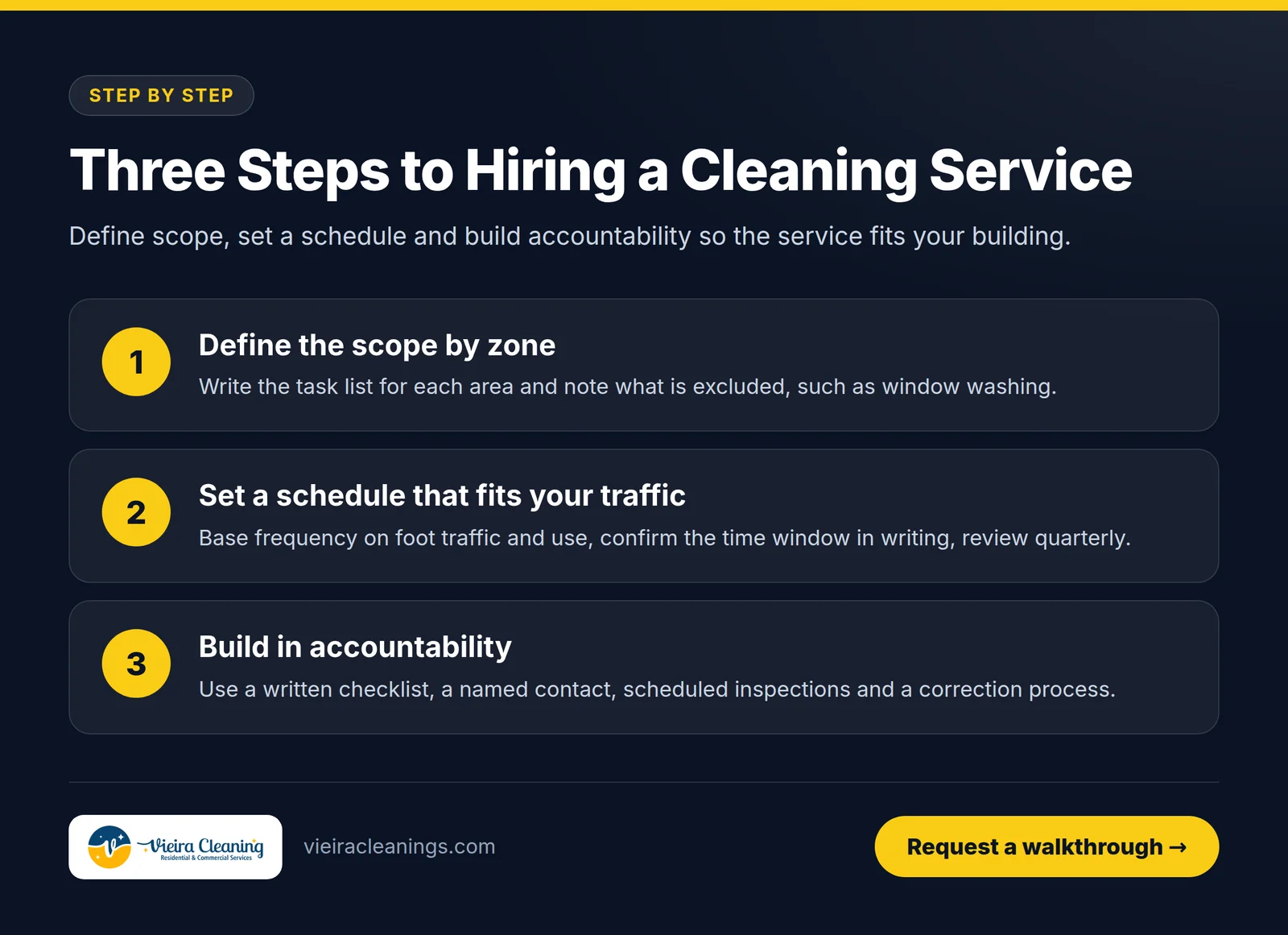
Step 1: Define the scope by zone
Step 2: Set a schedule that fits your traffic
Step 3: Build in accountability
Scope and schedule by facility type
Common mistakes when hiring
Questions to ask on the walkthrough
Request a walkthrough this week
The real cost of inconsistent cleaning
Inconsistent cleaning rarely shows up as one big failure. It shows up as a restroom that is spotless on Monday and neglected by Thursday, or a break room counter that nobody owns. Customers notice before you do, and employees quietly lose pride in the space.
The cost is spread across several places. Staff spend paid time on chores that are not their job. Frequently touched surfaces like door handles, shared keyboards and faucets stay dirty longer. Floors wear faster when grit is left to grind into finishes. Turnover of cleaning vendors adds its own cost, because every new crew needs months to learn your building.
The Statista overview of the U.S. commercial cleaning industry notes that commercial cleaning can provide a healthier environment for employees and visitors and also helps make a good impression. Both of those outcomes depend on consistency, not on one great cleaning followed by weeks of drift.
A simple way to see the problem in your own building is to track it for two weeks. Note how many times someone on your team handles a cleaning task, how many complaints come up about restrooms or floors, and how often supplies run out. Even a rough tally usually shows that the hidden labor and frustration cost more than most owners expect, and it gives you concrete numbers to bring to any provider.
Step 1: Define the scope by zone
Scope is the written list of tasks for each area. Vague scopes like “clean the office” are where most disputes begin. Walk your space and divide it into zones, then assign tasks to each.
Entry and reception: glass doors, floors, front desk surfaces, visitor seating.
Work areas: trash removal, dusting, vacuuming or mopping, desk-edge wiping (clear desks only).
Then separate the routine tasks from the periodic ones. Routine tasks happen every visit. Periodic tasks, such as baseboards, vents you can reach, and detailed floor work, happen monthly or quarterly. When periodic work needs a heavier push, a one-time deep cleaning service can reset the building before routine upkeep resumes.
Also note what is excluded. If window washing, carpet extraction or appliance interiors are not in the scope, write that down so nobody assumes they are covered. Clear exclusions prevent surprise add-on charges and make it easier to price those extras separately when you actually need them.
Step 2: Set a schedule that fits your traffic
Frequency should follow foot traffic and use, not habit. A five-person accounting office and a busy storefront on Main Street in Turlock do not need the same plan, even at the same square footage.
Consider three timing questions. When is the building empty enough for crews to work without disruption? Which areas get dirty fastest, such as restrooms and entries? And are there days, like a Monday after a weekend event, when extra attention pays off?
Many Central Valley businesses choose after-hours service so floors dry and chemicals clear before staff arrive. Others prefer early morning. Pick the window that protects your workday, then confirm it in writing so the crew arrives at the same time each visit.
Seasonality matters here too. Dust from dry summers and tracked-in mud during wetter months change how quickly entries and floors degrade, so a plan that works in July may need an extra entry-mat or mopping pass in winter. Build in a quarterly check to adjust.
Step 3: Build in accountability
Accountability is what separates a cleaning contract from a cleaning relationship. Without it, a missed task becomes your problem to chase.
A written checklist posted on site or shared digitally, so anyone can see what should have been done.
A named point of contact who responds to issues quickly.
Scheduled inspections where you and the provider walk the space together.
A correction process that fixes a missed item promptly without a new argument each time.
Consistency also depends on training. A crew that follows a documented system will clean the same way on a rushed Friday as on a calm Tuesday. That is the idea behind structured corporate cleaning training and facility systems.
Scope and schedule by facility type
The table below shows how scope and timing typically shift. These are starting points to discuss, not fixed packages, and your walkthrough will refine them.
Facility
Highest-priority areas
Typical timing to discuss
Small office
Restrooms, break room, entry, floors
After hours, a few visits per week
Retail store
Entry glass, sales floor, fitting or checkout areas
Before opening or after close, frequent visits
Medical or professional suite
Waiting room, restrooms, high-touch surfaces
After hours, regular visits tied to patient flow
Warehouse with office space
Office, restrooms, break area, walkways
Weekly or more, with periodic floor work
Gym or studio
Locker rooms, restrooms, floors, shared surfaces
Daily or near daily, off-peak hours
If your building is mostly offices, the office cleaning service page outlines what a standard routine looks like.
Common mistakes when hiring
Mistake 1: Choosing on the quote line alone
Two quotes can look similar and cover very different work. Compare the task lists, visit frequency and supplies included before comparing totals. A lower number often means a thinner scope.
Mistake 2: Skipping the walkthrough
A quote built from a phone call cannot account for a second restroom, a tile lobby or a storage room that doubles as a break area. Always insist on seeing the space first.
Mistake 3: Never revisiting the plan
Businesses change. A new hire wave, added hours or a remodel shifts what the building needs. Review scope every quarter, and read more on this theme in our guide to outsourcing janitorial services in Turlock.
Questions to ask on the walkthrough
Use the walkthrough to test the provider, not just to receive a price. Ask who will actually clean your building and whether the crew stays consistent. Ask how missed items are reported and corrected, which supplies and equipment are included, and how the team handles keys, alarms and after-hours access. A confident provider answers these specifics without hesitation.
What does commercial cleaning include, and what does it cost?
Commercial cleaning typically includes trash removal, restroom sanitizing, floor care, dusting and surface wiping in common areas. Specialty work is usually scoped separately. Pricing varies by square footage, frequency, floor types and task list, so any honest provider will quote after seeing the building rather than naming an hourly figure over the phone.
When you compare providers, look for clear scope, consistent crews and responsive communication. Our cleaning blog has more on evaluating facility programs.
Frequently Asked Questions
How much does commercial cleaning cost per hour?
Hourly rates vary widely, and most providers quote by scope rather than by the hour. Square footage, visit frequency, floor types and restroom count all shape the total. The reliable way to get an accurate figure is an on-site walkthrough followed by a written scope, so you can compare like for like.
What is included in commercial cleaning?
A standard plan usually covers trash removal, restroom cleaning, floor care, dusting and wiping of common surfaces. Periodic tasks like baseboards or deeper floor work are often scheduled monthly or quarterly. Ask for a written task list so nothing is assumed, and request separate scoping for any one-time projects.
How do I choose the best commercial cleaning company in Turlock?
Look for a provider that offers an on-site walkthrough, a written scope, consistent crews and a clear correction process. Ask how they train staff and handle missed tasks. Local familiarity with Central Valley businesses helps, but documented systems matter more than any slogan or review count.
How often should an office be professionally cleaned?
It depends on occupancy and traffic. Small offices often do well with a few visits per week, while busy storefronts or clinics may need near daily service. Restrooms and entries get dirty fastest, so start there and adjust frequency after the first month of observation.
Request a walkthrough this week
Pick one day this week, list the five zones above, and note where your current cleaning falls short. That list becomes the agenda for a walkthrough, where Vieira Cleaning looks at your space, your hours and your traffic, then proposes a scope and schedule in writing. Request your Turlock walkthrough today.
A pre-contract walkthrough is a short on-site visit where Vieira Cleaning tours your space, notes surfaces and traffic, and writes a scope listing areas, frequencies and expectations. Settle restrooms, entrances, break rooms, back-of-house zones, access, supplies and how you will judge the first month before signing, so your janitorial agreement matches how your Merced business really operates.
Key takeaways
Ask each provider for a written task list by area and frequency before comparing totals.
Layer frequencies: every visit, weekly, monthly and as needed, instead of one schedule for the whole building.
Name back-of-house areas such as storage rooms and loading zones, or they are likely left out.
Agree on keys, alarm codes, supplies and a named contact before the first night of service.
Plan a finished-space review with your manager after the first few weeks.
Before you sign a cleaning agreement, a walkthrough lets the provider see your space, hear your priorities and write a scope that matches both. For janitorial services Merced businesses depend on, that visit is where vague promises become a defined plan with named areas, set frequencies and clear expectations. Skip it, and you usually pay for it later in missed spots, surprise add-ons and awkward conversations with a crew that was never told what you wanted.
This guide walks through what happens during a Vieira Cleaning walkthrough, what to prepare, and which decisions to settle before anything is signed.
A walkthrough turns a vague bid into a defined scope
Step by step: what happens during the visit
Janitorial services Merced buyers should define area by area
How janitorial, commercial and office cleaning differ
Frequency decisions that shape the agreement
Common mistakes to avoid before you sign
Book your walkthrough this week
A walkthrough turns a vague bid into a defined scope
A quote built from square footage alone treats every building the same. A dental office, a Merced retail shop and a distribution warehouse can share a footprint and still need completely different work. Only a person standing in the space can see where traffic concentrates, which surfaces take the most abuse and what your customers notice first.
The visit also protects you. When the scope is written from what was actually seen, you have a document to measure the service against. If expectations drift six months in, you can point to the agreed list instead of relying on memory.
Step by step: what happens during the visit
The order below is how we typically run a walkthrough, so you know what to expect and can prepare.
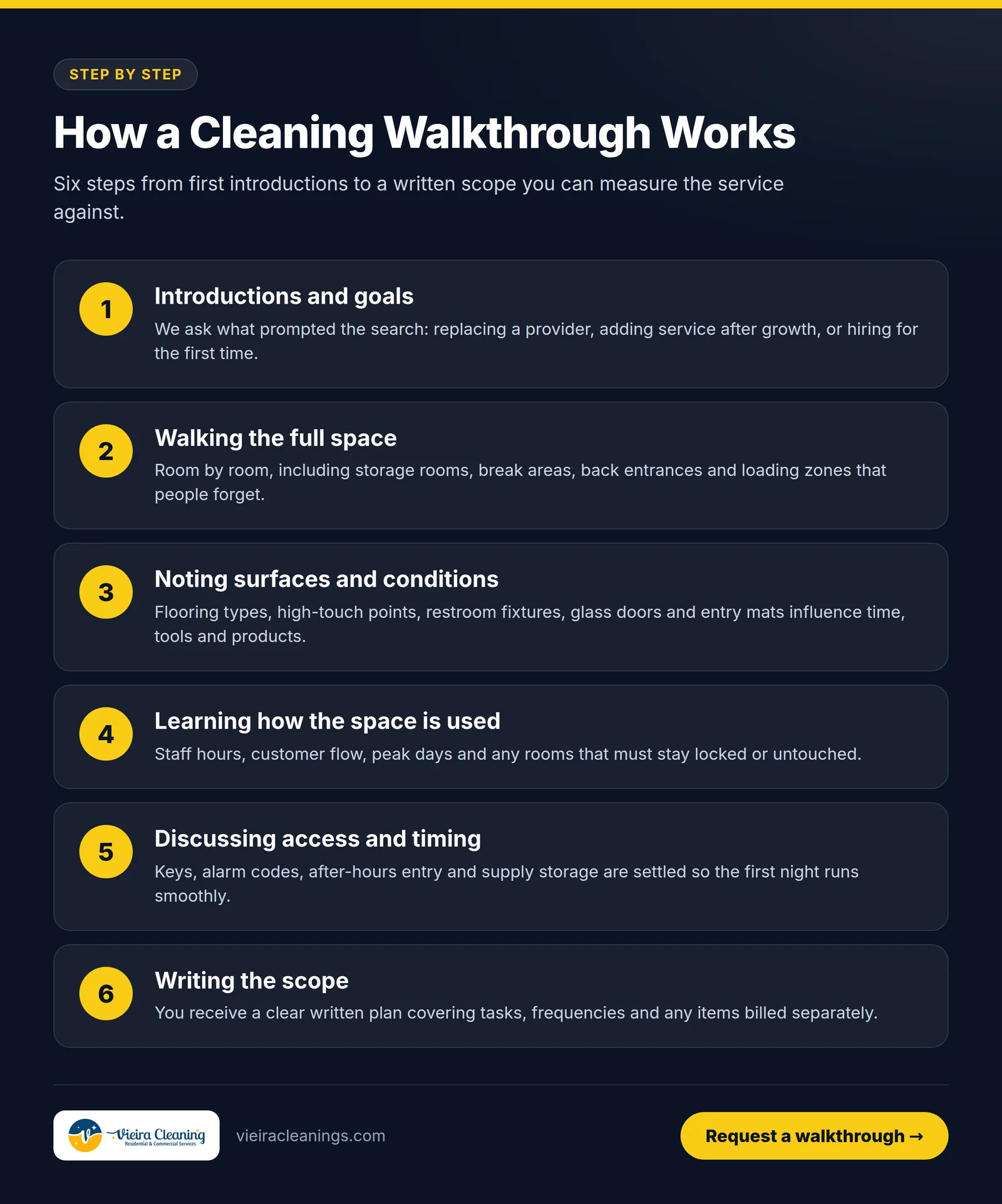
Introductions and goals. We start by asking what prompted the search. Are you replacing a provider, adding service after growth, or hiring for the first time?
Walking the full space. We go room by room, including areas people forget to mention, such as storage rooms, break areas, back entrances and loading zones.
Noting surfaces and conditions. Flooring types, high-touch points, restroom fixtures, glass doors and entry mats all influence time, tools and products.
Learning how the space is used. We ask about staff hours, customer flow, peak days and any rooms that must stay locked or untouched.
Discussing access and timing. Keys, alarm codes, after-hours entry and supply storage are settled here so the first night runs smoothly.
Writing the scope. You receive a clear written plan covering tasks, frequencies and any items billed separately.
Bring whoever will live with the result. An office manager notices different things than an owner, and a clinic lead sees details that a property manager may not.
Janitorial services Merced buyers should define area by area
The most useful thing you can do during the visit is attach a decision to every zone. The table below shows how that works in practice. The frequencies are examples of the kind of choice you will make, not a fixed menu.
Area
What we look at
Decision to make
Entrance and lobby
Door glass, mats, hard flooring, reception counter
Daily wipe-down, or daily plus a weekly detail pass
Daily surfaces, with a scheduled day for appliance exteriors
Private offices and meeting rooms
Confidential papers, personal items, tables
Which rooms are cleaned, which are skipped, and who unlocks them
Storage, back-of-house and loading areas
Dust, debris, floor condition, safety paths
Weekly or monthly, and who clears items first
Notice that most rows end in a choice, not a price. Once those choices are made, the cost follows from the scope instead of the other way around.
How janitorial, commercial and office cleaning differ
People often ask whether cleaning and janitorial service are the same thing. Not quite. A one-time clean addresses a space once. Janitorial service is the recurring routine that keeps a building at a steady standard, week after week. The U.S. Census Bureau profile for janitorial services describes the industry as establishments primarily engaged in cleaning building interiors.
So what is included? A typical janitorial scope covers trash removal, restroom sanitizing and restocking, floor care, dusting and high-touch surface cleaning. Anything beyond the routine, such as a deep reset before an inspection, is scoped separately.
The line between janitorial and commercial cleaning is mostly about breadth. Commercial cleaning is the wider category covering many business types and project types. Janitorial is the ongoing maintenance inside it. If your space is mainly desks and meeting rooms, our office cleaning services may be the closer fit, and the walkthrough helps us tell you honestly which one you need. For more on how local offices approach this, read our post on commercial cleaning for Merced offices.
Frequency decisions that shape the agreement
Frequency is where most agreements either work or quietly fail. Too little, and the building slips between visits. Too much, and you pay for work nobody can see. The walkthrough is the moment to match visit frequency to how the space is actually used.
Think in layers instead of one schedule for everything:
Every visit: trash, restrooms, entrances, break room surfaces and floors in high-traffic paths.
Weekly: dusting of lower surfaces, detailed floor edges, partition wiping and interior glass doors.
Monthly or seasonal: baseboards, vents you can reach from the floor, storage areas and a deeper floor pass.
As needed: a reset after a busy season, a move, a renovation or a long closure. Our deep cleaning services cover that kind of one-time reset.
Seasonal context matters in the Central Valley. Dry summer dust tracks in through every door, and winter rain brings mud into entryways. A business in Merced may want extra entry attention at different times of year than one in Hilmar or Turlock. Tell us about those patterns and we will build them into the plan.
Common mistakes to avoid before you sign
Mistake 1: Comparing quotes with different scopes
Two quotes can look similar and cover very different work. Ask each provider for a written task list by area and frequency, then compare lists before comparing totals. Our janitorial contract guide explains which clauses deserve a second read.
Mistake 2: Leaving out the places staff rarely see
Storage rooms, back hallways and loading zones are easy to forget on a tour. If they are not named in the scope, they are usually not cleaned. Mention them during the visit, even if the answer is that they stay off the list for now.
Mistake 3: Skipping the conversation about supplies and access
Who provides paper products, who holds keys and what happens if an alarm trips are small details with big consequences. Settle them in writing, along with a named contact on each side for questions.
Mistake 4: Having no way to measure the result
Agree on how you will judge the first month. A simple walkthrough of the finished space with your manager, plus a short check-in after the first few weeks, catches small gaps before they become habits.
What to prepare before the walkthrough
A little preparation shortens the visit and sharpens the scope. Gather the following before we arrive:
Your staff schedule and the hours the building is empty
A short list of past cleaning frustrations, so we know what to fix first
Any areas with security, privacy or compliance needs
Your must-have outcomes, such as a polished entrance for client meetings
Questions about your current provider’s gaps, if you are switching
Frequently Asked Questions
What is the difference between cleaning and janitorial services?
Cleaning can be a single event, while janitorial service is a recurring routine that keeps a building at a steady standard. Janitorial work usually includes trash removal, restroom care, floor care and high-touch surfaces on a set schedule. One-time resets, such as a deep clean before an inspection, are typically scoped as separate projects.
What is included in janitorial services?
Most scopes cover trash and recycling removal, restroom sanitizing and restocking, vacuuming and mopping, dusting, and wiping of desks, counters and handles. The exact list depends on your building. That is why the walkthrough matters: it turns a general list into named tasks for each area and a frequency for each one.
What is the difference between janitorial and commercial cleaning?
Commercial cleaning is the broader category covering work in many business settings, including one-time projects. Janitorial service is the ongoing maintenance within it. A business with steady daily use usually wants janitorial scheduling, while a space needing a one-time reset may start with a project before moving to a recurring plan.
Should I attend the walkthrough myself?
Yes, or send the person who will oversee the service day to day. Owners, office managers and facility leads each notice different details. Having the decision-maker present means priorities, access rules and off-limits rooms are settled in one conversation instead of passed along secondhand.
Book your walkthrough this week
The best next step is a short visit while your questions are fresh. Pick a day when the space is in normal use, bring the person who will oversee the service, and plan to leave with a written scope covering areas, frequencies and expectations. If anything in the plan feels off, say so during the visit. Adjusting a document is easy, and changing a signed agreement is not.