Book post construction cleaning after the last trade leaves and before furniture or staff move in. Join the contractor’s final walkthrough, agree on a written scope, and plan three stages: rough clean, final clean and a touch-up before opening day. Cost depends on square footage, debris, finishes and visits, so a walkthrough quote is the most reliable way to compare providers.
Key takeaways
Join the contractor’s final walkthrough and note delicate finishes before cleaning begins.
Put the scope, number of visits and finish date in writing.
Schedule a short touch-up visit after furniture delivery and before opening.
Compare quotes by what is included, not by the total alone.
Set up routine janitorial service so the opening standard lasts.
To open on time, you book the final clean after the contractor finishes punch-list work and before furniture, inventory or staff move in. That sequence is what keeps post construction cleaning Modesto projects on schedule. Construction dust, adhesive residue and leftover debris do not wait politely until opening day, and a space that looks finished can still fail a tenant’s first walk-through.
Bring your cleaning partner in before the contractor leaves
Your timeline from final walkthrough to opening day
The three cleaning stages and what each one covers
Is post construction cleaning worth it?
What shapes the cost of a construction cleanup
Common mistakes that delay openings
Next step: schedule a walkthrough
Bring your cleaning partner in before the contractor leaves
Most delays start with one assumption: that the contractor’s crew will hand over a clean building. In practice, builders typically remove large debris and materials, but detailed cleaning is a separate scope. Ask for it in writing before the final payment is released.
Who cleans up after construction? Either the general contractor subcontracts it, or you hire a cleaning company directly. Hiring directly gives you control over the schedule and the standard. It also means one team is accountable for the result, instead of a punch list that bounces between trades.
A tenant improvement in a Modesto office and a new retail buildout leave very different messes, so your cleaning plan should match the actual project, not a generic template.
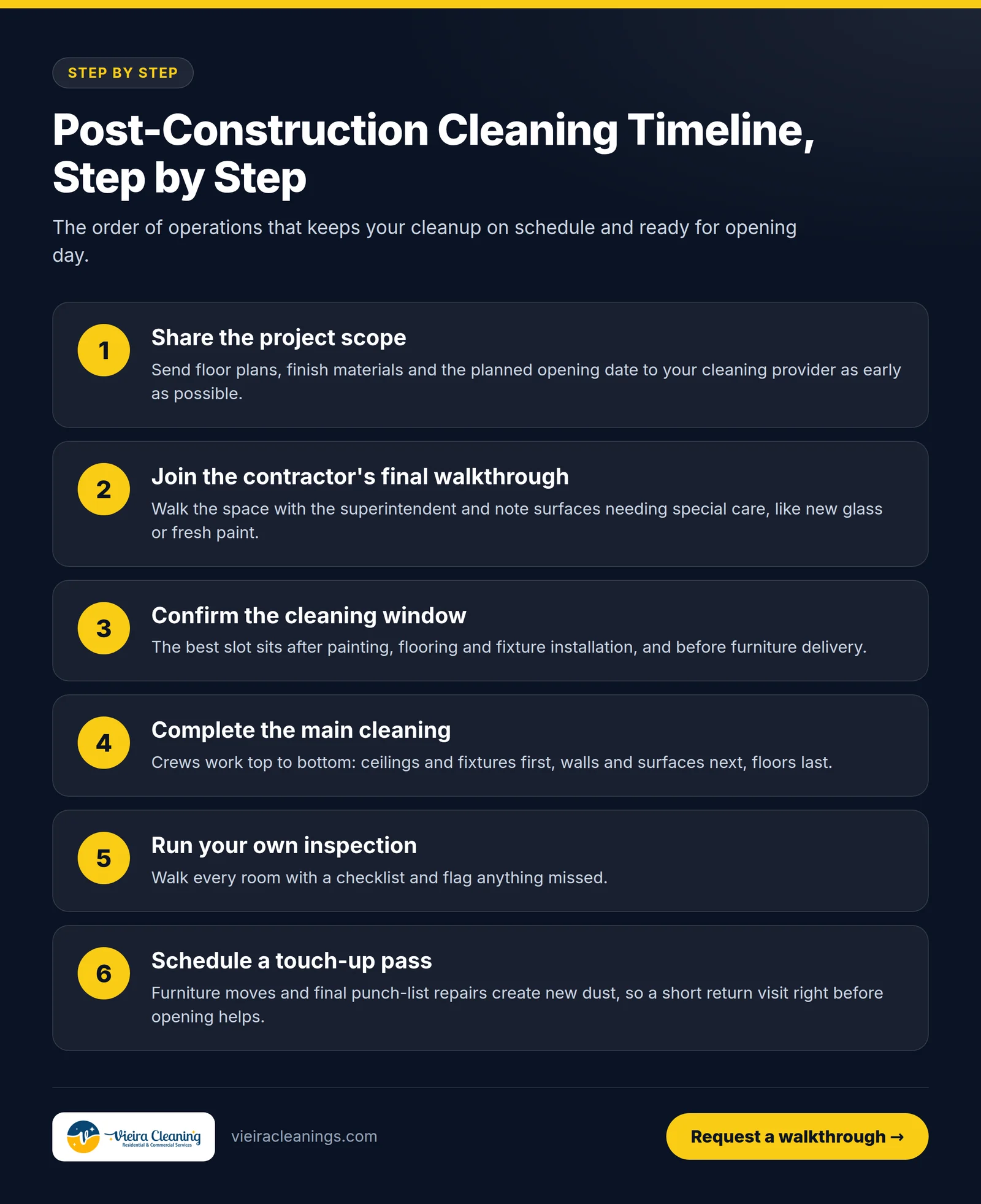
Your post construction cleaning Modesto timeline, step by step
Use this order of operations. It works for tenant improvements, retail buildouts, clinic remodels and warehouse office additions across Modesto, Turlock and Merced.
Share the project scope. Send floor plans, finish materials and the planned opening date to your cleaning provider as early as possible.
Join the contractor’s final walkthrough. Walk the space with the superintendent and note surfaces that need special care, such as new glass, stainless steel, sealed concrete or fresh paint.
Confirm the cleaning window. The best slot sits after painting, flooring and fixture installation, and before furniture delivery.
Complete the main cleaning. Crews work top to bottom: ceilings and fixtures first, walls and surfaces next, floors last.
Run your own inspection. Walk every room with a checklist and flag anything missed.
Schedule a touch-up pass. Furniture moves and final punch-list repairs create new dust, so a short return visit right before opening protects your first impression.
Hand over to routine service. Set up ongoing janitorial or office cleaning so the standard holds after day one.
The three cleaning stages and what each one covers
Professional crews usually split the work into stages. The names vary between companies, but the logic is the same: remove the heavy mess first, then detail, then polish.
Stage
When it happens
Typical tasks
What you confirm
Rough clean
While trades are still finishing
Debris removal, sweeping, dust removal from open areas
Trash hauling is handled and access is clear
Final clean
After the last trade leaves
Surface wiping, cabinets and fixtures, restrooms, floors, interior glass, stickers and labels removed
Every room matches your checklist
Touch-up clean
Just before opening day
Dust from furniture setup, fingerprints, floor spots, restroom restock check
Space is move-in or customer ready
Skipping the first stage forces the final crew to spend its time on bulk removal. Skipping the last one means your staff or first customers meet the dust that settled after delivery day.
Is post construction cleaning worth it?
Yes, when you weigh it against the alternatives. Fine construction dust travels into vents, shelving, electronics and every horizontal surface, and general-purpose janitorial routines are not built to remove it. Your own staff would lose days of productivity, and finished surfaces can be scratched by the wrong tools.
There is also the professional image to consider. A medical clinic, retail store or office that opens with visible residue tells tenants and customers that details were missed. Our guide to the benefits of post construction cleaning for your facility goes deeper on the health and productivity side.
What shapes the cost of a construction cleanup
People often ask what the prices are for this work and how cleaners charge. The honest answer is that a reliable quote comes from a walkthrough, not a phone guess. Most providers price by square footage, scope, or a combination of both, so ask which method is used.
These factors move the quote:
Total square footage and number of rooms or floors
Amount of debris and residue left after trades finish
Finish types, such as polished concrete, tile, glass walls or stainless steel
Number of visits needed (rough, final, touch-up)
Access, such as elevators, stairs or tight loading windows
Your deadline and whether work must happen after hours
Ask every provider to list exactly what is included, so you can compare scopes rather than totals. A lower number that leaves out restrooms or interior glass often costs more once you add the missing work back in.
Common mistakes that delay openings
Mistake 1: Scheduling cleaning too early
If painters or flooring crews are still on site, the cleaning gets undone within days. Confirm the last trade’s departure date and book the final clean directly after it.
Mistake 2: No written scope
Verbal agreements lead to arguments about restrooms, cabinets or glass. Put the scope, the number of visits and the finish date in a short written document.
Mistake 3: Forgetting the touch-up visit
Furniture delivery, shelving installs and inventory stocking all create dust. Budget a short return pass so the space is photo-ready on the day you open.
Walk every room with the contractor’s punch list and your cleaning scope side by side
Check corners, baseboards, door tops, vents covers and light fixtures for dust
Inspect restrooms, break rooms and kitchenettes for residue and stickers
Look at floors under bright light, since streaks and film show up at an angle
Confirm trash and recycling bins are placed and stocked
Test that exits, hallways and entries are clear and safe to walk
Our team handles every stage of this process through our post construction cleaning services, coordinated around your contractor’s schedule here in the Central Valley.
Frequently Asked Questions
What are the prices for post construction cleaning?
Prices vary by project, so a walkthrough is the only reliable way to get one. Providers usually weigh square footage, debris level, finish types and number of visits. Ask each company to itemize inclusions such as restrooms, interior glass and the touch-up pass, so you compare equal scopes.
Who cleans up after construction?
The contractor removes large debris and materials, but detailed cleaning is usually separate. Either the contractor subcontracts it or you hire a cleaning company directly. Hiring directly gives you control over timing and quality, and you can add it to the contract before final payment.
How do cleaners charge for post construction cleanup?
Most charge by square foot, by a flat project rate, or by hourly crew time. Flat rates work best when the scope is clear. Hourly pricing suits unpredictable projects. Ask what happens if the site is dirtier than expected, so there are no surprise add-ons.
Can cleaning start before the final inspection?
A rough clean can start earlier, but the final clean should wait until inspections and punch-list repairs are done. Repairs and re-inspections create new dust and marks. Scheduling the detailed clean afterward avoids paying twice for the same surfaces.
Next step: schedule a walkthrough before the punch list closes
The best time to talk to a cleaning partner is while the contractor is still on site, because that is when dates can still be aligned. Bring your floor plan, finish list and target opening date, and you will leave with a clear scope and timeline. Request a walkthrough with Vieira Cleaning and get your space ready for opening day.
Schedule a commercial deep clean when routine janitorial work stops reaching buildup, typically at seasonal changes (late spring and early fall), before a lease ends, and before a new tenant or reopening. Book off-hours, define the scope in writing after a walkthrough, and follow with a regular cleaning program so the baseline lasts.
Key takeaways
Plan deep cleans around late spring and early fall in the Central Valley.
Book the lease turnover clean after move-out and before the final inspection.
Choose weekends or evenings and work in zones to protect operations.
Focus detail work on restrooms, break rooms, and entry areas first.
Update your routine cleaning scope after each deep clean.
A Modesto facility needs a scheduled deep clean when routine janitorial work no longer reaches the buildup that forms in corners, on high surfaces, and under equipment, and the best timing is usually tied to a seasonal change, a lease turnover, or a reopening. Planning deep cleaning services Modesto owners can rely on means choosing the date before the problem shows up in front of customers or staff.
Why routine cleaning and deep cleaning are different jobs
Timing trigger 1: seasonal changes in the Central Valley
Timing trigger 2: lease turnover and move-out
Timing trigger 3: new tenants and reopenings
What a commercial deep clean covers
A step-by-step plan with minimal disruption
Common scheduling mistakes
Your next step
Routine janitorial work and deep cleaning solve different problems
Nightly or weekly janitorial service keeps a space presentable. It empties trash, restrooms get restocked and sanitized, floors are vacuumed or mopped, and visible surfaces are wiped. That rhythm protects your professional image day to day.
A deep clean goes where the routine does not. Think baseboards, vent covers, door frames, light fixtures, the backs of reception counters, break room appliances, and the grout lines in restrooms. These areas collect residue slowly, so nobody notices until a client points it out.
The two services work best together. Our janitorial services handle the consistent upkeep, while a scheduled reset brings the whole building back to a clean baseline that the routine can then maintain.
Timing trigger 1: seasonal changes in the Central Valley
Modesto has dry, dusty summers and a wetter stretch in winter, and both leave a mark indoors. Dust and fine grit travel in on shoes and through open doors, while rainy weeks bring mud and moisture onto entry floors and mats.
Two natural windows tend to work well for most offices, clinics, and retail stores:
Late spring: clear out winter buildup before the heavy summer foot traffic and heat.
Early fall: reset after dusty summer months and before the holiday rush, year-end client visits, and open enrollment season.
Agricultural activity around Modesto, Turlock, and Merced also puts extra dust into the air during harvest periods. Warehouses and shop-front businesses near open fields often notice it on windowsills, shelving, and entry floors first.
Timing trigger 2: lease turnover and move-out
When a lease ends, the condition of the space affects your security deposit conversation and how fast the unit can be shown or re-let. A deep clean before the final walkthrough removes the buildup that normal cleaning leaves behind, so the landlord inspects a space that looks cared for.
For property managers, the same logic applies between tenants. A clean, neutral unit photographs better, shows better, and avoids disputes about what was or was not left behind.
Book the clean after the last furniture and equipment are out, but before the final inspection. Leave at least a day of buffer in case a second visit is needed for touch-ups.
Timing trigger 3: new tenants and reopenings
A new tenant moving into a vacant suite inherits whatever the previous occupant left, plus dust that settled while the space sat empty. Starting with a deep clean means staff begin work in a space that feels ready, and your routine cleaning program starts from a fair baseline.
Reopenings follow the same pattern. After a remodel, a long closure, or a seasonal shutdown, a reset helps the doors open on a clean space. If the reopening follows construction work, a dedicated post-construction cleaning comes first, and the deep clean finishes the details.
What a commercial deep clean typically covers
Scope varies by building, which is why a walkthrough matters. The table below shows how routine work and a scheduled deep clean usually divide the tasks.
Area
Routine janitorial
Scheduled deep clean
Restrooms
Sanitize fixtures, restock, mop
Scrub grout, descale fixtures, wipe partitions and vent covers
Break room
Wipe counters, empty trash
Clean inside and behind appliances, cabinet fronts, sink fixtures
Floors
Vacuum and mop open areas
Edges, corners, under movable furniture, detailed hard-floor cleaning
Work areas
Dust visible surfaces, empty bins
Baseboards, door frames, high ledges, light fixture exteriors
Entry and reception
Wipe glass doors and counters
Detail work on handles, thresholds, seating, and walls
Pricing depends on square footage, layout, and condition, so we quote after seeing the space rather than guessing from a number. You can read more about our approach on the deep cleaning services page.
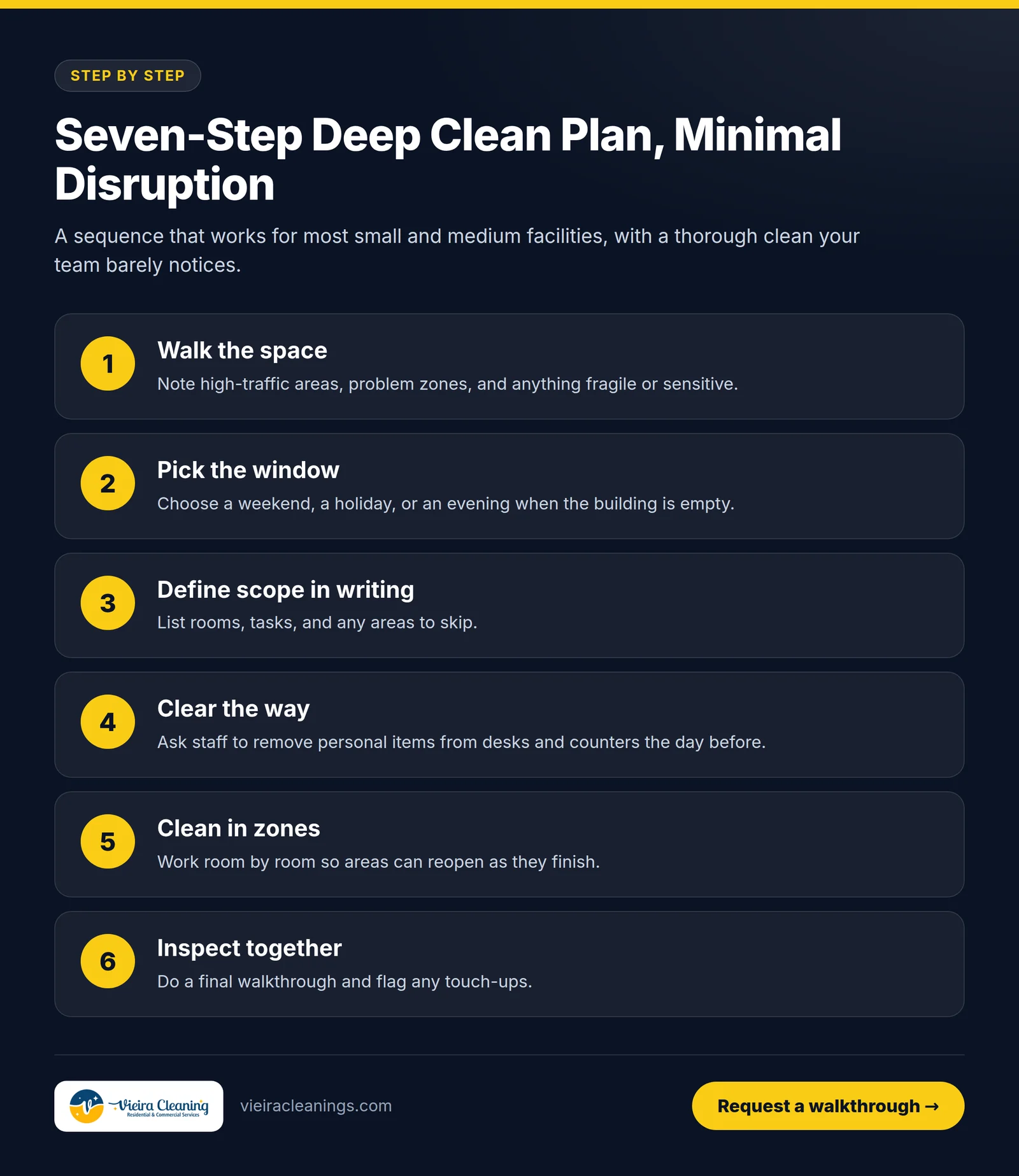
A step-by-step plan with minimal disruption
The goal is a thorough clean that your team barely notices. This sequence works for most small and medium facilities.
Walk the space. Note high-traffic areas, problem zones, and anything fragile or sensitive.
Pick the window. Choose a weekend, a holiday, or an evening when the building is empty.
Define scope in writing. List rooms, tasks, and any areas to skip.
Clear the way. Ask staff to remove personal items from desks and counters the day before.
Clean in zones. Work room by room so areas can reopen as they finish.
Inspect together. Do a final walkthrough and flag any touch-ups.
Hand off to routine service. Update the regular cleaning scope based on what the deep clean revealed.
Medical and retail spaces benefit from extra care with scheduling, since patient hours and store hours limit the open windows. For a primer on building a plan around your hours, see our guide to what a janitorial contract in Modesto should cover.
Common scheduling mistakes
Mistake 1: Waiting for a visible problem
By the time a client comments on dusty vents or a stained break room, trust has already taken a small hit. Schedule on a calendar, twice a year for many offices, instead of reacting.
Mistake 2: Booking during peak hours
Cleaning around active staff slows the job and frustrates everyone. Off-hours service protects both quality and productivity.
Mistake 3: Skipping the follow-up routine
A deep clean without a good regular program fades fast. Pair it with consistent service, such as the options covered in our office cleaning services in Modesto post.
Mistake 4: Assuming every room needs the same attention
Restrooms, break rooms, and entries usually need the most detail. A targeted scope saves time and keeps the focus where visitors notice.
Frequently Asked Questions
How much should I expect to pay for a deep clean?
Cost depends on square footage, layout, and how much buildup has accumulated, so reliable pricing comes from a walkthrough rather than a flat number. A small office and a multi-room clinic need very different time and labor. Ask for a written scope so you can compare quotes on the same tasks.
What is typically included in a commercial deep clean?
A deep clean usually covers detail work that routine service skips, such as baseboards, door frames, high ledges, restroom grout, break room appliances, and floor edges. Exact tasks vary by building. Confirm the list in writing before the visit, and note any areas that should be excluded.
How often should an office schedule a deep clean?
Many offices schedule one twice a year, often in late spring and early fall. Higher-traffic spaces such as clinics or retail stores may need it more often. Your walkthrough findings and visitor volume are better guides than a fixed rule.
Can a deep clean happen without closing my business?
Usually yes, if the work is done off-hours or in zones. Evenings, weekends, and holidays work best, and cleaning room by room lets areas reopen as they finish. Some tasks, like detailed floor work, need a space to be empty for a few hours.
Request a walkthrough for your Modesto facility
If your building is approaching a seasonal change, a lease end, or a new opening, the best time to plan is a few weeks ahead. Our team will review the space, agree on scope, and schedule the work around your hours. Request a walkthrough and quote from Vieira Cleaning to get a date on the calendar.
A practical tip: put your deep clean dates on the same shared calendar you use for inspections, renewals, and staff events. When the date is visible months ahead, it is far easier to protect the evening or weekend slot, and your team can plan around it without last-minute surprises.
Choose commercial cleaning in Turlock by defining scope zone by zone, setting frequency based on foot traffic, and requiring written checklists, a named contact and regular inspections. Insist on an on-site walkthrough before any quote, since scope differences, not totals, explain most price gaps between providers.
Key takeaways
Divide your building into five zones and assign routine and periodic tasks to each.
Match visit frequency to foot traffic, with restrooms and entries getting the most attention.
Require a written checklist, a named contact and scheduled joint inspections.
Compare task lists before comparing quote totals.
Review scope every quarter as staffing, hours or layout change.
Hiring commercial cleaning Turlock businesses can count on comes down to three decisions: what gets cleaned, how often, and who answers when something is missed. Get those wrong and you pay for it in sick days, tired-looking lobbies and staff who start emptying their own trash cans. This guide walks you through each decision so the service you sign fits your building instead of a generic template.
The real cost of inconsistent cleaning
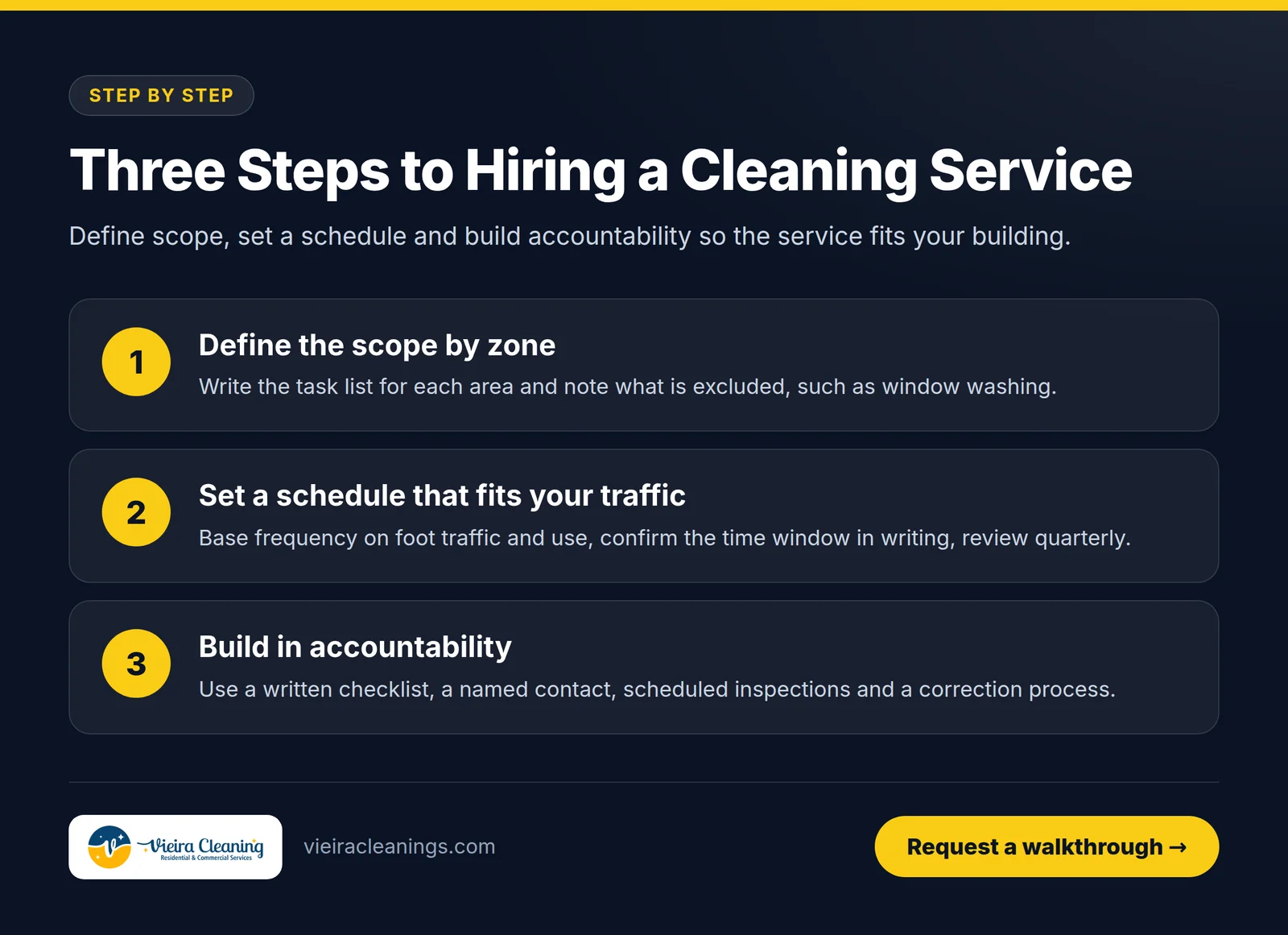
Step 1: Define the scope by zone
Step 2: Set a schedule that fits your traffic
Step 3: Build in accountability
Scope and schedule by facility type
Common mistakes when hiring
Questions to ask on the walkthrough
Request a walkthrough this week
The real cost of inconsistent cleaning
Inconsistent cleaning rarely shows up as one big failure. It shows up as a restroom that is spotless on Monday and neglected by Thursday, or a break room counter that nobody owns. Customers notice before you do, and employees quietly lose pride in the space.
The cost is spread across several places. Staff spend paid time on chores that are not their job. Frequently touched surfaces like door handles, shared keyboards and faucets stay dirty longer. Floors wear faster when grit is left to grind into finishes. Turnover of cleaning vendors adds its own cost, because every new crew needs months to learn your building.
The Statista overview of the U.S. commercial cleaning industry notes that commercial cleaning can provide a healthier environment for employees and visitors and also helps make a good impression. Both of those outcomes depend on consistency, not on one great cleaning followed by weeks of drift.
A simple way to see the problem in your own building is to track it for two weeks. Note how many times someone on your team handles a cleaning task, how many complaints come up about restrooms or floors, and how often supplies run out. Even a rough tally usually shows that the hidden labor and frustration cost more than most owners expect, and it gives you concrete numbers to bring to any provider.
Step 1: Define the scope by zone
Scope is the written list of tasks for each area. Vague scopes like “clean the office” are where most disputes begin. Walk your space and divide it into zones, then assign tasks to each.
Entry and reception: glass doors, floors, front desk surfaces, visitor seating.
Work areas: trash removal, dusting, vacuuming or mopping, desk-edge wiping (clear desks only).
Then separate the routine tasks from the periodic ones. Routine tasks happen every visit. Periodic tasks, such as baseboards, vents you can reach, and detailed floor work, happen monthly or quarterly. When periodic work needs a heavier push, a one-time deep cleaning service can reset the building before routine upkeep resumes.
Also note what is excluded. If window washing, carpet extraction or appliance interiors are not in the scope, write that down so nobody assumes they are covered. Clear exclusions prevent surprise add-on charges and make it easier to price those extras separately when you actually need them.
Step 2: Set a schedule that fits your traffic
Frequency should follow foot traffic and use, not habit. A five-person accounting office and a busy storefront on Main Street in Turlock do not need the same plan, even at the same square footage.
Consider three timing questions. When is the building empty enough for crews to work without disruption? Which areas get dirty fastest, such as restrooms and entries? And are there days, like a Monday after a weekend event, when extra attention pays off?
Many Central Valley businesses choose after-hours service so floors dry and chemicals clear before staff arrive. Others prefer early morning. Pick the window that protects your workday, then confirm it in writing so the crew arrives at the same time each visit.
Seasonality matters here too. Dust from dry summers and tracked-in mud during wetter months change how quickly entries and floors degrade, so a plan that works in July may need an extra entry-mat or mopping pass in winter. Build in a quarterly check to adjust.
Step 3: Build in accountability
Accountability is what separates a cleaning contract from a cleaning relationship. Without it, a missed task becomes your problem to chase.
A written checklist posted on site or shared digitally, so anyone can see what should have been done.
A named point of contact who responds to issues quickly.
Scheduled inspections where you and the provider walk the space together.
A correction process that fixes a missed item promptly without a new argument each time.
Consistency also depends on training. A crew that follows a documented system will clean the same way on a rushed Friday as on a calm Tuesday. That is the idea behind structured corporate cleaning training and facility systems.
Scope and schedule by facility type
The table below shows how scope and timing typically shift. These are starting points to discuss, not fixed packages, and your walkthrough will refine them.
Facility
Highest-priority areas
Typical timing to discuss
Small office
Restrooms, break room, entry, floors
After hours, a few visits per week
Retail store
Entry glass, sales floor, fitting or checkout areas
Before opening or after close, frequent visits
Medical or professional suite
Waiting room, restrooms, high-touch surfaces
After hours, regular visits tied to patient flow
Warehouse with office space
Office, restrooms, break area, walkways
Weekly or more, with periodic floor work
Gym or studio
Locker rooms, restrooms, floors, shared surfaces
Daily or near daily, off-peak hours
If your building is mostly offices, the office cleaning service page outlines what a standard routine looks like.
Common mistakes when hiring
Mistake 1: Choosing on the quote line alone
Two quotes can look similar and cover very different work. Compare the task lists, visit frequency and supplies included before comparing totals. A lower number often means a thinner scope.
Mistake 2: Skipping the walkthrough
A quote built from a phone call cannot account for a second restroom, a tile lobby or a storage room that doubles as a break area. Always insist on seeing the space first.
Mistake 3: Never revisiting the plan
Businesses change. A new hire wave, added hours or a remodel shifts what the building needs. Review scope every quarter, and read more on this theme in our guide to outsourcing janitorial services in Turlock.
Questions to ask on the walkthrough
Use the walkthrough to test the provider, not just to receive a price. Ask who will actually clean your building and whether the crew stays consistent. Ask how missed items are reported and corrected, which supplies and equipment are included, and how the team handles keys, alarms and after-hours access. A confident provider answers these specifics without hesitation.
What does commercial cleaning include, and what does it cost?
Commercial cleaning typically includes trash removal, restroom sanitizing, floor care, dusting and surface wiping in common areas. Specialty work is usually scoped separately. Pricing varies by square footage, frequency, floor types and task list, so any honest provider will quote after seeing the building rather than naming an hourly figure over the phone.
When you compare providers, look for clear scope, consistent crews and responsive communication. Our cleaning blog has more on evaluating facility programs.
Frequently Asked Questions
How much does commercial cleaning cost per hour?
Hourly rates vary widely, and most providers quote by scope rather than by the hour. Square footage, visit frequency, floor types and restroom count all shape the total. The reliable way to get an accurate figure is an on-site walkthrough followed by a written scope, so you can compare like for like.
What is included in commercial cleaning?
A standard plan usually covers trash removal, restroom cleaning, floor care, dusting and wiping of common surfaces. Periodic tasks like baseboards or deeper floor work are often scheduled monthly or quarterly. Ask for a written task list so nothing is assumed, and request separate scoping for any one-time projects.
How do I choose the best commercial cleaning company in Turlock?
Look for a provider that offers an on-site walkthrough, a written scope, consistent crews and a clear correction process. Ask how they train staff and handle missed tasks. Local familiarity with Central Valley businesses helps, but documented systems matter more than any slogan or review count.
How often should an office be professionally cleaned?
It depends on occupancy and traffic. Small offices often do well with a few visits per week, while busy storefronts or clinics may need near daily service. Restrooms and entries get dirty fastest, so start there and adjust frequency after the first month of observation.
Request a walkthrough this week
Pick one day this week, list the five zones above, and note where your current cleaning falls short. That list becomes the agenda for a walkthrough, where Vieira Cleaning looks at your space, your hours and your traffic, then proposes a scope and schedule in writing. Request your Turlock walkthrough today.
A reliable start with office cleaning in Modesto includes an in-person walkthrough, a written scope customized to your space, a schedule that fits your business hours, regular quality inspections, and one clear contact for issues. Pricing depends on square footage, layout, restrooms, floor types and frequency, so a visit-based proposal is the fairest way to compare providers.
Key takeaways
Ask for an in-person walkthrough before accepting any quote.
Require a written scope listing tasks by area and frequency.
Confirm who inspects the work and how misses get corrected.
Name one point of contact and a response window up front.
Watch for crew turnover and empty supplies in the first month.
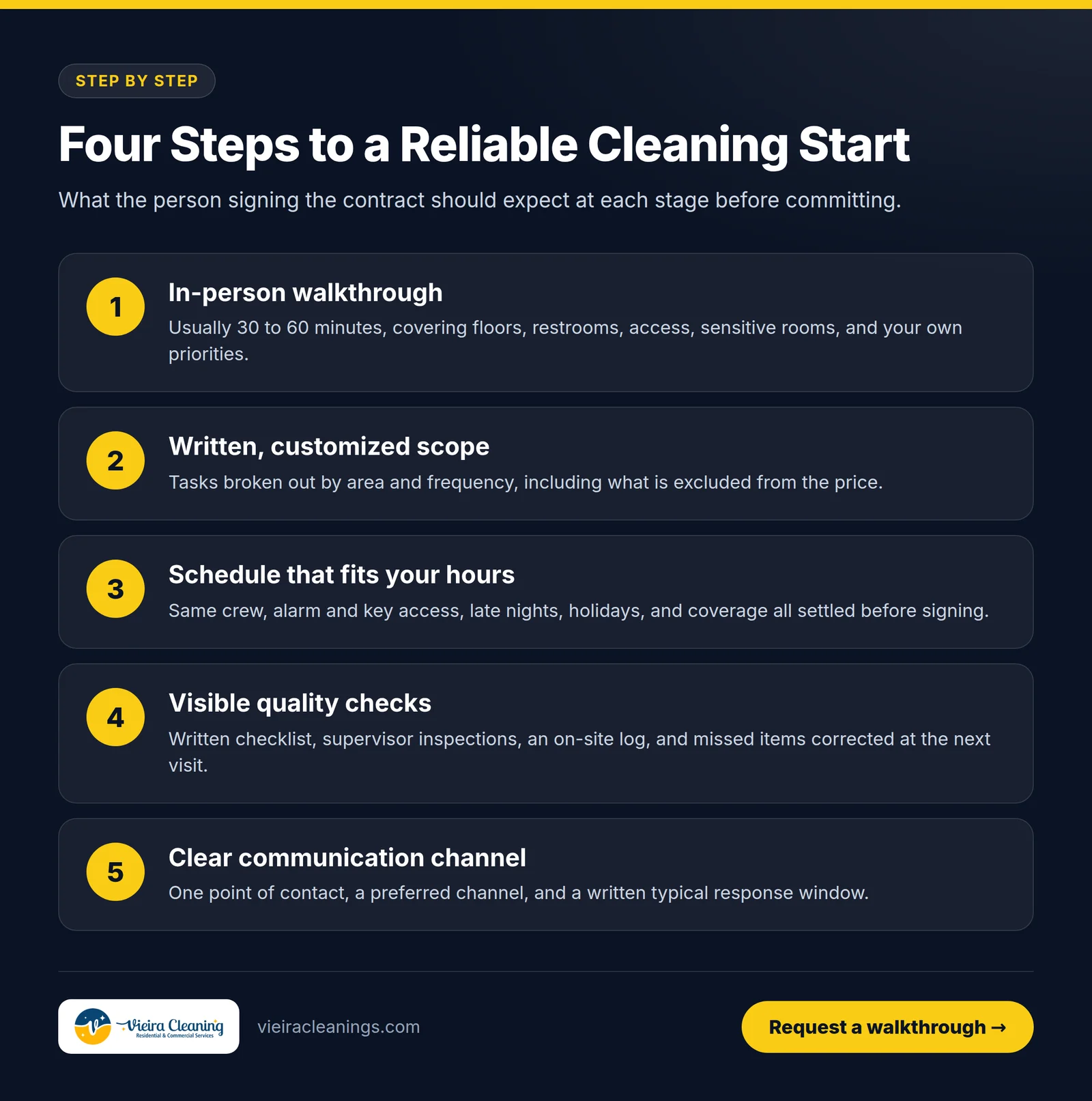
A reliable start with office cleaning services Modesto businesses depend on begins with an in-person walkthrough, a written scope built around your space, a schedule that stays out of your team’s way, and a clear way to report problems. If a provider skips any of those four steps, expect inconsistent results by the second month. This guide shows the person signing the contract what each stage should look like.
The walkthrough comes first
A customized scope in writing
Scheduling around business hours
Quality checks you can see
Communication that keeps small issues small
What pricing depends on
Your next step
The walkthrough comes first
A quote sent without anyone visiting your office is a guess. A professional partner walks the space with you, usually for 30 to 60 minutes depending on size, and looks at what a phone call cannot show.
During the visit, expect questions about floor types, how many people use each restroom, where clients enter, and which rooms hold sensitive equipment or paperwork. A good walkthrough also covers access: keys, alarm codes, parking, and who to call if the door is locked.
Bring your own list too. If the break room is the first thing employees complain about, or the front lobby is what visitors judge you by, say so. Those priorities should show up in the final plan.
Before the visit ends, the provider should tell you what happens next and when to expect the written proposal. A typical turnaround is one to three business days. If a week passes with no word, that is an early look at how communication will go once the contract starts.
A customized scope, not a generic package
A one-size menu rarely fits a Modesto office. A small accounting firm with carpeted offices has different needs than a two-story suite with a shared kitchen and a steady stream of walk-in clients. The scope should be written, specific, and tied to frequency.
Ask to see tasks broken out by area and by how often they happen. Our office cleaning services are built this way, so nothing is left to assumption.
Area
Typical nightly tasks
Typical weekly or monthly tasks
Reception and lobby
Vacuum or mop floors, wipe glass doors and counters, empty trash
Dust vent covers and ledges, spot clean walls
Restrooms
Disinfect fixtures, restock supplies, mop floors
Descale fixtures, detail grout and partitions
Break room
Wipe counters and tables, clean sink, empty trash
Clean microwave interior, wipe cabinet fronts
Workstations
Empty bins, dust cleared surfaces
Detail dust on shelves and monitor stands
Also ask what is excluded. Interior window washing, carpet extraction, and floor stripping and waxing are often priced separately, and it is better to know that before the first invoice than after it.
If you need a one-time reset before regular service starts, a deep cleaning can bring a neglected space up to a baseline so routine visits stay manageable.
Scheduling around business hours
Most offices are cleaned after closing, but that is not the only option. Early mornings before opening work well for some teams, and a few businesses prefer a light daytime presence for restrooms and common areas.
What matters is that the schedule fits how you actually work. Ask the provider these questions before you sign:
Who is on site, and will it be the same crew each visit?
How do they handle your alarm and key access?
What happens if your office stays open late for a deadline?
How do you reschedule for holidays or closures?
Who covers if a team member is out?
Central Valley weather matters too. Summer dust and winter rain both change what gets tracked onto entry floors, so a good plan accounts for seasonal wear at the front door.
Quality checks you can see
Reliable cleaning is verified, not assumed. Look for a provider that inspects its own work using a written checklist, and that invites you to walk the space and flag anything missed.
A simple routine works well. A supervisor checks key areas on a regular schedule, a short log or checklist stays on site, and any missed item gets corrected at the next visit, or sooner for urgent issues. Our janitorial services follow this kind of system because consistency is what clients keep us for.
Training matters here as well. Crews that understand product use, surface care, and cross-contamination between restrooms and kitchens make fewer mistakes. We cover that in our corporate cleaning training work for teams that want stronger in-house systems.
Communication that keeps small issues small
Every office has a moment when something is missed or a one-off mess needs attention. What separates a good partner is how quickly the issue is acknowledged and fixed.
Agree on a single point of contact and a preferred channel, whether that is a phone call, text, or email. Ask for a typical response window in writing. Also agree on how special requests work, such as cleaning up after a client event or a staff lunch.
Common warning signs in the first month
The crew changes every week with no notice
Supplies in restrooms run out between visits
No one can tell you who inspects the work
Complaints are answered with delays instead of fixes
One or two of these in a single week may be a hiccup. The same issue appearing three weeks in a row is a pattern, and it is worth raising with your contact right away, in writing, so there is a record of what was agreed.
What pricing depends on
Many buyers ask how much office cleaning costs per hour or per visit. The honest answer is that it depends on square footage, layout, frequency, number of restrooms, floor types, and the level of detail in the scope. Two offices of the same size can need very different amounts of time.
This is why a walkthrough matters. A written proposal tied to your actual scope lets you compare providers fairly, and it protects you from vague hourly figures that hide what is and is not covered. The real value to weigh against any quote is a healthier space for your team and visitors and a front door that makes a good first impression.
Hourly figures vary widely, so treat them cautiously. Rates depend on crew size, supplies and scope, and an hourly number can hide what is excluded. A written proposal based on a walkthrough, with tasks and frequency listed, gives you a clearer basis for comparing providers.
How much should I charge to clean a 2,000 square foot office?
There is no single fair number, because layout matters as much as size. Restroom count, floor types, desk density and visit frequency change the time needed. If you are pricing the work, measure those factors first and test them during a walkthrough.
How often should an office be cleaned?
Most offices do well with several visits per week, while smaller or low-traffic spaces may need fewer. Restrooms and break rooms usually drive the schedule. Start with a frequency that matches foot traffic, then adjust after the first month.
Should I be present during the first cleaning?
It helps to be there or to have a manager on site for the first visit. You can confirm access, point out priorities and review the checklist together. After that, a short follow-up walkthrough catches anything that needs adjusting.
Do I need a contract to start office cleaning?
Most providers use a written agreement so the scope, schedule and expectations are clear for both sides. Read the terms on cancellation, notice periods and service changes before you sign, and ask for anything unclear to be written down.
Your next step with office cleaning services Modesto teams can rely on
Start by listing your priorities, your hours, and the areas that matter most to clients and staff. Then ask for a walkthrough, a written scope, and a named contact before you commit. A provider that welcomes those requests is usually one that will deliver month after month.
Common commercial cleaning mistakes such as inconsistent schedules, neglected high-touch areas, and the wrong products hurt workplace health and image. Central Valley businesses avoid them with a consistent, customized cleaning plan and trained staff. Partnering with a professional like Vieira Cleaning keeps offices, clinics, and warehouses safe and clean.
Common commercial cleaning mistakes undermine the health, safety, and professional image of your workplace. For small and medium-sized businesses in California’s Central Valley, avoiding these errors is essential for a productive, welcoming environment. Whether you manage an office, medical clinic, retail store, gym, or warehouse, knowing where cleaning usually falls short lets you fix it.
What Are the Most Frequent Commercial Cleaning Mistakes?
Inconsistent Cleaning Schedules: Skipped tasks let dirt, germs, and allergens build up.
Using the Wrong Products: Harsh or inappropriate chemicals can damage surfaces and pose health risks.
Neglecting High-Touch Surfaces: Doorknobs, light switches, and shared equipment are often missed.
Poor Staff Training: Untrained personnel use ineffective techniques or skip critical areas.
Ignoring Vents and Dust Traps: Surface cleaning alone leaves dust in vents and fixtures.
Overlooking Clutter and Repairs: Cluttered spaces and broken fixtures complicate cleaning.
One-Size-Fits-All Plans: A generic checklist doesn’t address each facility’s needs.
Why Do These Mistakes Matter for Your Business?
Health Risks: Ineffective cleaning spreads illness and increases absenteeism.
Lower Productivity: Unclean environments distract and demotivate staff.
Damaged Reputation: Clients and visitors judge your professionalism by cleanliness.
Higher Maintenance: Poor cleaning wears out surfaces and equipment faster.
How Can You Avoid Common Commercial Cleaning Mistakes?
Set a Consistent Schedule: Daily, weekly, and monthly tasks tailored to your facility.
Use the Right Products: EPA-registered disinfectants and surface-appropriate cleaners.
Train Cleaning Staff: Ongoing education on protocols, products, and safety.
Include Vents and Fixtures: Add dusting of vents, returns, and lights to the plan.
Fix Clutter and Repairs Quickly: Organized spaces are easier to clean.
Customize the Plan: Clinics need stricter sanitization than warehouses, for example.
Generic vs. Customized Cleaning Plans
Approach
Pros
Cons
Generic Cleaning Plan
Simple to implement
Misses industry-specific needs
Customized Cleaning Plan
Targets real risks, better results
Requires an initial walkthrough
What Role Does Professional Commercial Cleaning Play?
Outsourcing to a trusted provider like Vieira Cleaning brings expert knowledge, consistent quality, and the right equipment. Professional commercial cleaning services address the specific challenges of offices, clinics, retail stores, gyms, and warehouses in the Central Valley. Regular deep cleaning goes beyond daily maintenance, while post construction cleaning prepares spaces for safe occupancy.
How to Select the Right Commercial Cleaning Partner?
Experience in Your Industry: Expertise with your type of facility.
Customized Services: Flexible plans that scale with your business.
It depends on the facility, but generally daily for high-touch areas and monthly or quarterly for deep cleaning.
Why is customizing a cleaning plan important?
Customized plans address specific industry needs, surfaces, and usage to make cleaning more effective.
What benefits come from hiring professional commercial cleaners?
Expertise, consistent quality, safety standards, and customized service that improve your workplace and image.
What should happen when a commercial cleaning task is missed?
Report it to your cleaning provider the same day so the task is redone at the next visit or sooner, then add it to the written checklist so the team confirms it every visit. A dependable provider gives you one point of contact for these reports.
Next Step for Your Facility
Common commercial cleaning mistakes put workplace health, safety, and appearance at risk. By recognizing these pitfalls and using a tailored, consistent cleaning plan, Central Valley businesses create healthier environments and better first impressions. Request a walkthrough with Vieira Cleaning to review your current cleaning plan.
Commercial cleaning services help businesses maintain clean and safe environments that attract more customers. By enhancing first impressions, ensuring health compliance, and improving employee productivity, these services drive business success while supporting safety and hygiene.
Commercial cleaning services are essential for businesses aiming to maintain a clean, safe, and welcoming environment for employees, clients, and visitors. These services go beyond basic janitorial tasks by offering customized cleaning solutions that improve workplace health, safety, and productivity. In this article, we will explore why investing in commercial cleaning services benefits your business and attracts more customers.
What Are Commercial Cleaning Services?
Commercial cleaning services refer to professional cleaning solutions designed specifically for business facilities such as offices, medical clinics, retail stores, gyms, warehouses, and other commercial spaces. These services include regular janitorial tasks like dusting, vacuuming, trash removal, and restroom sanitation, as well as specialized cleaning such as floor care, window washing, and disinfecting high-touch surfaces.
Key Components of Commercial Cleaning Services
Office Cleaning: Dusting desks, emptying trash, sanitizing phones and keyboards.
Restroom Sanitation: Deep cleaning toilets, sinks, and replenishing supplies.
Floor Maintenance: Sweeping, mopping, vacuuming, and polishing floors.
Window Cleaning: Removing dirt and streaks for clearer views and better lighting.
Specialized Disinfection: Targeting germs in high-traffic areas like lobbies and break rooms.
How Clean Spaces Attract More Customers
Maintaining a spotless commercial environment has a direct impact on customer perception and business success. Here are several ways commercial cleaning services help attract more customers:
Enhanced First Impressions: A clean and well-maintained space immediately communicates professionalism and care, encouraging customers to trust your business.
Health and Safety Compliance: Regular cleaning reduces the risk of illness and complies with health regulations, especially critical for clinics and food establishments.
Improved Customer Experience: Customers feel more comfortable and valued when visiting clean and organized facilities.
Positive Word of Mouth: Satisfied customers are more likely to recommend your business based on a pleasant environment.
Increased Employee Productivity: A clean workspace boosts employee morale and efficiency, which indirectly enhances customer service quality.
Maintaining Safety with Professional Cleaning
Safety is a top priority in any commercial setting. Professional cleaning services focus not only on appearance but also on reducing hazards:
Disinfecting High-Touch Areas: Door handles, light switches, and elevator buttons are cleaned regularly to prevent germ spread.
Proper Waste Disposal: Timely removal of trash and hazardous materials prevents accidents and contamination.
Slip and Fall Prevention: Floors are cleaned and dried promptly to avoid slippery surfaces.
Use of Eco-Friendly Products: Many services use green cleaning agents that reduce chemical exposure for workers and customers.
Choosing the Right Commercial Cleaning Provider
Selecting a reliable cleaning service is crucial. Consider these factors when evaluating providers:
Criteria
Why It Matters
Questions to Ask
Experience
Ensures understanding of industry-specific needs
How long have you serviced businesses like mine?
Customization
Allows tailored cleaning plans for your facility
Can you adjust schedules and services based on my requirements?
Certifications
Indicates professional standards and training
Are your staff trained and certified in cleaning best practices?
Safety Protocols
Protects employees and customers
What safety measures do you follow during cleaning?
Customer Support
Ensures timely communication and issue resolution
How do you handle complaints or special requests?
Benefits of Long-Term Cleaning Partnerships
Working with a commercial cleaning company on a long-term basis offers several advantages:
Consistent Quality: Regular service ensures spaces stay clean and well-maintained.
Customized Plans: Providers can adapt services as your business needs evolve.
Cost Efficiency: Bundled services and scheduled cleanings reduce overall expenses.
Trust and Reliability: Familiarity with your facility enables more thorough and efficient cleaning.
How Vieira Cleaning Supports Your Business
As a professional cleaning company based in California, Vieira Cleaning specializes in customized commercial cleaning services for small and medium-sized businesses. Their focus on consistency, health, and productivity helps offices, clinics, retail stores, gyms, and warehouses maintain safe and attractive environments. Learn more about their offerings on the Commercial Cleaning Services page.
For tips and updates on maintaining clean business spaces, visit the Vieira Cleaning blog, featuring articles on janitorial trends and best practices.
Frequently Asked Questions
What types of businesses benefit most from commercial cleaning services?
Offices, medical clinics, retail stores, gyms, warehouses, and other commercial facilities benefit greatly from professional cleaning services.
How often should a business schedule commercial cleaning?
Cleaning frequency depends on the business type and foot traffic, ranging from daily janitorial services to weekly or monthly deep cleaning.
Are eco-friendly cleaning products used in commercial cleaning?
Many commercial cleaning providers use eco-friendly products to reduce chemical exposure and promote healthier indoor air quality.
Can commercial cleaning services help with health and safety compliance?
Yes, professional cleaning helps maintain sanitary conditions, reduce germ spread, and meet industry health regulations.
Conclusion
Investing in commercial cleaning services is a strategic decision that benefits businesses in multiple ways. Clean, safe, and well-maintained spaces improve customer perceptions, enhance employee productivity, and ensure compliance with health standards. Partnering with a reliable cleaning provider like Vieira Cleaning creates a healthier environment that attracts more customers and supports long-term business growth. By prioritizing cleanliness and safety, your business can stand out in competitive markets and foster lasting relationships with clients.