TL;DR
A janitorial services agreement in Modesto should list tasks by zone, state visit frequency including weekly and periodic work, define who supplies chemicals and consumables, name contacts and response times, and schedule regular inspections. Clear written scope prevents missed tasks and gives you a standard to measure the provider against.
Key takeaways
- Write the scope as a room-by-room task list with a frequency beside each task.
- Separate every-visit, weekly, monthly and periodic tasks so deep work does not get skipped.
- Decide in writing who buys chemicals, equipment and restroom consumables.
- Add a correction clause so missed tasks are fixed within an agreed time.
- Check renewal terms, cancellation notice and insurance before signing.
A good cleaning agreement lists every task, every visit day, who supplies what, who you call, and how quality gets checked. When a contract for janitorial services Modesto businesses sign leaves those details out, the result is predictable: restrooms get done but break rooms get skipped, trash is emptied on some nights and not others, and nobody can point to a line that says what was promised.
- Why vague contracts fail
- Scope of work: the task list
- Frequency and schedule
- Supplies and equipment
- Communication and quality checks
- Contract terms to read twice
- Common mistakes
- Next step: a walkthrough
Why vague contracts lead to inconsistent cleaning
Most cleaning disputes are not about bad intent. They come from two sides holding different pictures of the same sentence, such as "nightly office cleaning." To the owner it means desks wiped and floors done. To the crew it may mean trash and vacuuming only.
A written scope removes the guesswork. It also protects the cleaning company, because the crew knows exactly what success looks like on every visit.
Scope of work: what janitorial services Modesto contracts should list
The scope should be a room-by-room list, not a paragraph. The U.S. Census Bureau describes the janitorial industry as establishments primarily engaged in cleaning building interiors, according to its janitorial services industry profile. That is a wide definition, which is exactly why your agreement must narrow it to your building.
Break the scope into zones and assign each task a frequency:
- Restrooms: sanitize fixtures, refill dispensers, mop floors, empty waste.
- Offices and workstations: trash, dusting, desk surfaces if cleared, vacuuming.
- Break rooms: counters, sink, microwave exterior, table wipe-down, floors.
- Entrances and lobbies: glass doors, mats, floors, high-touch points.
- Floors: sweeping, mopping, vacuuming, plus any periodic machine scrubbing.
Also write down what is excluded. If the agreement does not cover tasks like interior fridge cleanouts or moving heavy furniture, say so, and note how extras are requested and priced. If you need a one-time reset, a separate deep cleaning service can be scheduled instead of stretching the nightly scope.
Frequency and schedule: daily, weekly and periodic tasks
Janitorial work runs on layers. Some tasks happen every visit, some weekly, some monthly or quarterly. A contract that only states "five nights a week" hides the periodic work that keeps a space from slowly degrading.
| Task layer | Example tasks | What to write down |
|---|---|---|
| Every visit | Trash removal, restroom sanitizing, floor care in high-traffic areas | Days of the week and service window, such as after 6 p.m. |
| Weekly | Detailed dusting, break room deep wipe, mop of all hard floors | Which day each task falls on |
| Monthly | Baseboards, vent grille dusting, partition glass | Calendar month and sign-off method |
| Periodic | Machine floor scrubbing, high dusting | Frequency and whether it costs extra |
Be specific about access too. Note alarm codes, key handling, who unlocks, and what happens if the building is closed on a holiday. A clinic with early patients and a warehouse with a night shift need very different windows, so put the actual hours in writing.
Supplies and equipment: decide who provides what
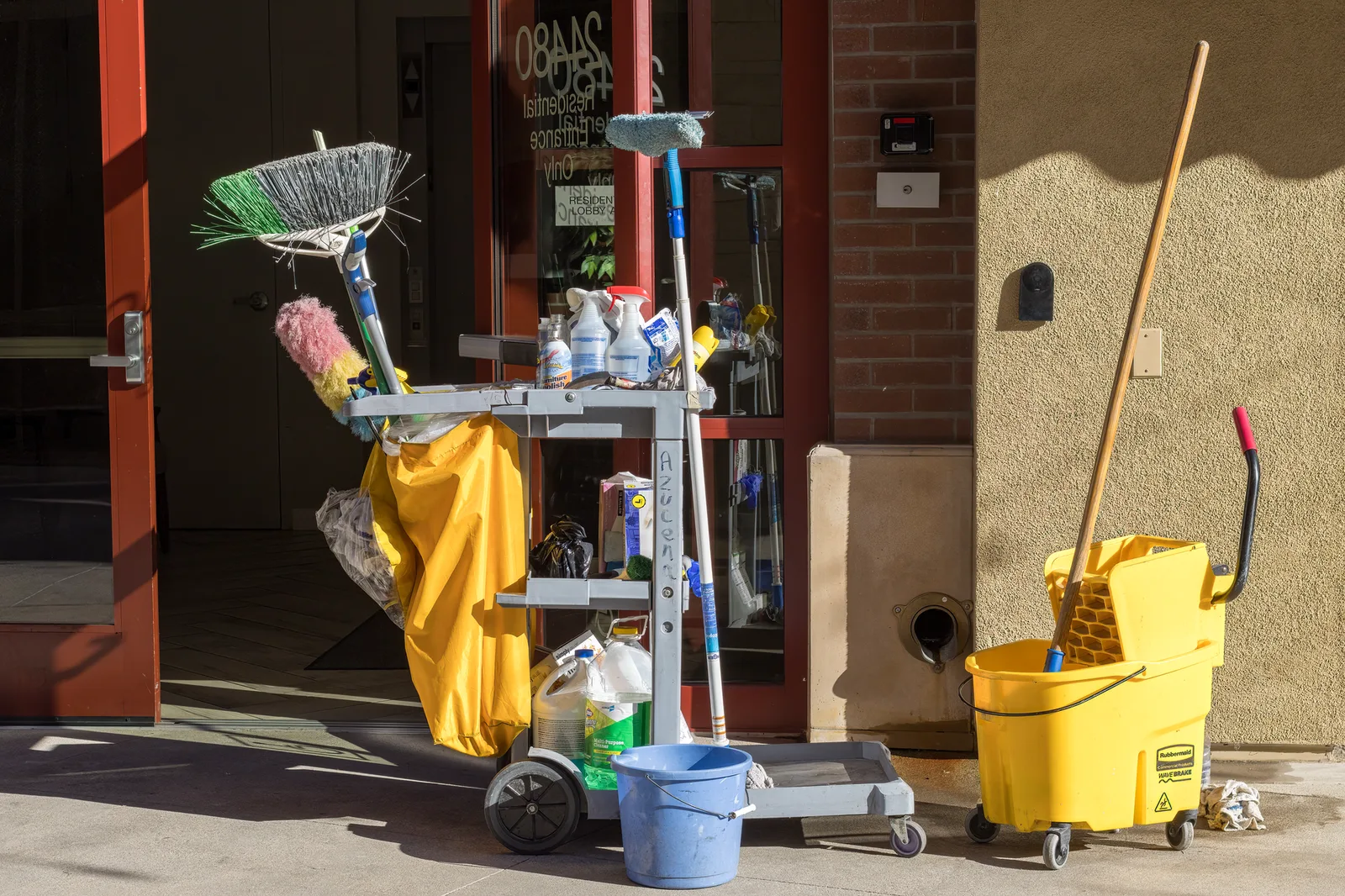
Supplies are the most common hidden argument. Spell out whether the cleaning company brings its own chemicals, vacuums and mops, and who buys consumables such as paper towels, toilet tissue, soap and trash liners.
A simple split works well: the provider supplies all cleaning chemicals and equipment, while the client either buys consumables or the provider restocks them and bills at an agreed method. Whatever you choose, write it down and name the product categories. If your space has sensitive surfaces or you want specific products used, add that here.
Ask for safety data sheets on the chemicals used in your building. OSHA’s hazard communication rules expect chemical information to be available to workers, so a reputable provider will have this ready.
Communication and quality checks that keep service consistent
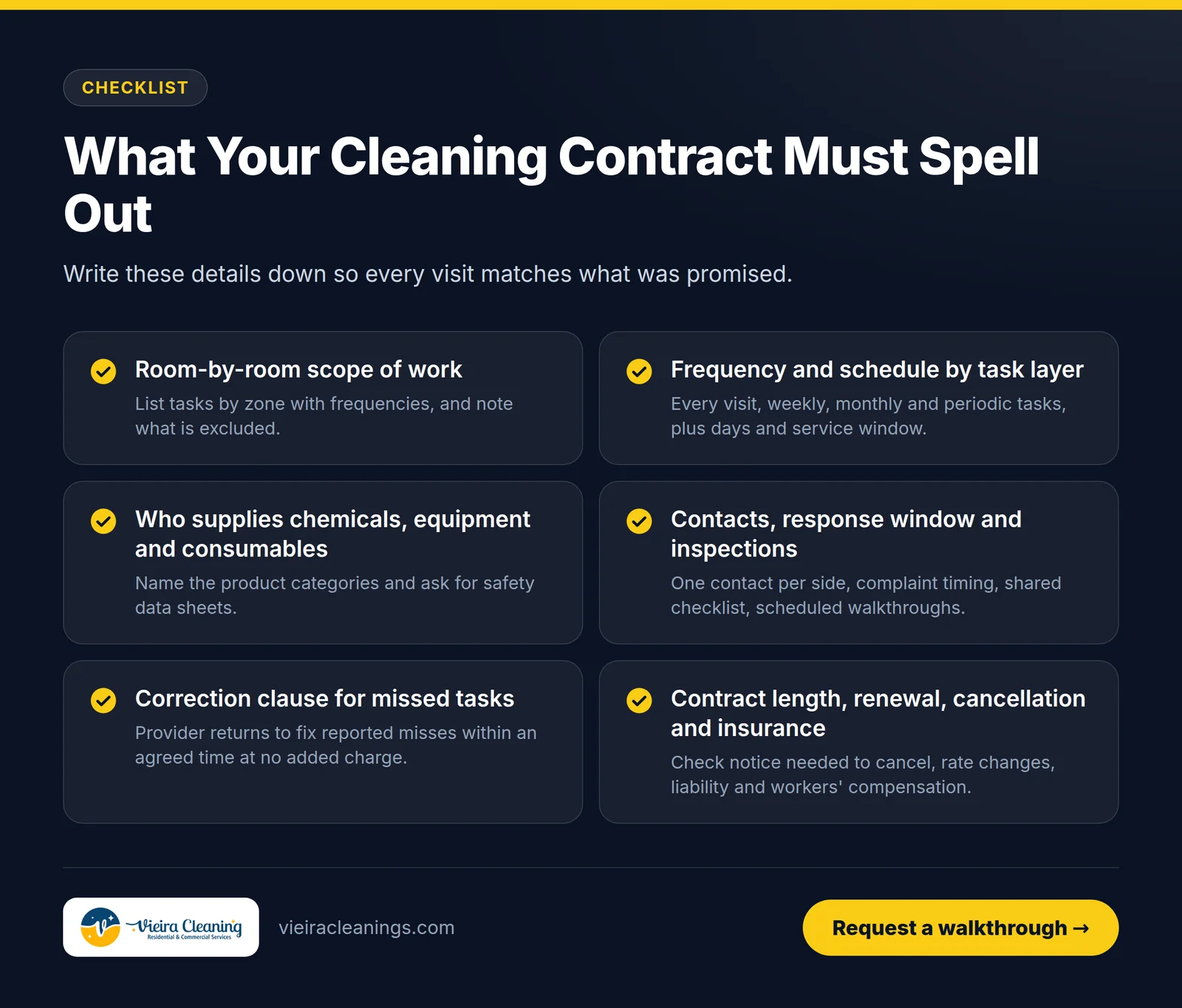
Cleaning happens when you are not there, so the contract has to build in ways to see the work. Four items belong in writing:
- One point of contact on each side, with a phone number and email.
- A response window for complaints, such as same day or next business day.
- A shared checklist left on site or reviewed digitally so each visit is confirmed.
- Scheduled inspections, for example a walkthrough every month or quarter with a supervisor.
Add a correction clause too: if a missed task is reported, the provider returns to fix it within an agreed time at no added charge. That single sentence changes how a crew treats the checklist.
Training matters here as well. A crew that understands your facility systems performs more consistently, which is why some businesses pair their agreement with corporate cleaning training for in-house staff who handle daytime touch-ups.
Contract terms to read twice
Beyond the cleaning itself, check the business terms. Look for the contract length, renewal language, notice needed to cancel, and how rate changes are handled. A long auto-renewal with a short cancellation window can lock you in even when service slips.
Confirm insurance as well: general liability coverage and workers' compensation for the crew. Ask who is responsible if something is damaged, and how claims are reported. Staffing stability is worth asking about too, since the same trained people on site each week produce steadier results. For more on weighing providers before you sign, see our guide on choosing a commercial cleaning service in Modesto.
Common mistakes when signing a cleaning agreement
Mistake 1: Describing the service in one sentence
"Office cleaning as needed" invites disagreement. Replace it with a zone list and frequencies, even if it takes a full page.
Mistake 2: Ignoring periodic tasks
Baseboards, high dusting and floor scrubbing rarely get done unless they are on a calendar. Add them with dates.
Mistake 3: No review process
If nobody inspects, quality drifts. Put a recurring walkthrough in the agreement and keep notes.
Mistake 4: Comparing only the monthly total
Two quotes can look similar while covering different work. Compare the task lists line by line before you compare totals. Our post on outsourcing janitorial services in the Central Valley covers how to think about that tradeoff.
Frequently Asked Questions
What is the difference between cleaning and janitorial services?
Cleaning usually means a specific task or one-time job, while janitorial services are recurring, scheduled upkeep of a building. Janitorial work covers routine tasks like restrooms, trash and floors on a set calendar. Many businesses also add periodic work such as machine floor care, which should be listed separately in the agreement.
What is included in janitorial services?
Typical janitorial services include trash removal, restroom sanitizing, floor care, dusting, break room cleaning and entrance upkeep. Exact inclusions vary by provider, so the contract should list each task and its frequency. Anything not written down, such as inside appliances or moving furniture, may be treated as an extra.
What is the difference between janitorial and commercial cleaning?
Janitorial services focus on ongoing maintenance of a facility, while commercial cleaning is a broader term that can include one-time projects and specialty work. The two often overlap. What matters is that your agreement states the routine tasks, the periodic tasks and how extra requests are handled.
How is janitorial service usually priced?
Pricing typically depends on square footage, number of restrooms, floor types, visit frequency and the task list. Because those factors differ for every building, a provider should walk your space before quoting. Compare proposals by scope line by line, not just by the monthly total.
How long should a janitorial contract last?
Contract length is negotiable, and shorter initial terms let you confirm service quality before committing longer. Read the renewal language and cancellation notice carefully, since automatic renewals with short exit windows can be hard to leave. Ask for a clear process to address problems before termination.
Next step: request a walkthrough of your space
The best contracts start with someone walking your building, noting the restrooms, floor types, traffic patterns and after-hours access, then writing a scope that matches. Vieira Janitorial & Cleaning Services, based in Hilmar, builds agreements that way for offices, clinics, retail stores, gyms and warehouses across Modesto and the Central Valley. Request a walkthrough of your space and get a written scope you can actually hold your cleaning partner to.