TL;DR
A pre-contract walkthrough is a short on-site visit where Vieira Cleaning tours your space, notes surfaces and traffic, and writes a scope listing areas, frequencies and expectations. Settle restrooms, entrances, break rooms, back-of-house zones, access, supplies and how you will judge the first month before signing, so your janitorial agreement matches how your Merced business really operates.
Key takeaways
- Ask each provider for a written task list by area and frequency before comparing totals.
- Layer frequencies: every visit, weekly, monthly and as needed, instead of one schedule for the whole building.
- Name back-of-house areas such as storage rooms and loading zones, or they are likely left out.
- Agree on keys, alarm codes, supplies and a named contact before the first night of service.
- Plan a finished-space review with your manager after the first few weeks.
Before you sign a cleaning agreement, a walkthrough lets the provider see your space, hear your priorities and write a scope that matches both. For janitorial services Merced businesses depend on, that visit is where vague promises become a defined plan with named areas, set frequencies and clear expectations. Skip it, and you usually pay for it later in missed spots, surprise add-ons and awkward conversations with a crew that was never told what you wanted.
This guide walks through what happens during a Vieira Cleaning walkthrough, what to prepare, and which decisions to settle before anything is signed.
- A walkthrough turns a vague bid into a defined scope
- Step by step: what happens during the visit
- Janitorial services Merced buyers should define area by area
- How janitorial, commercial and office cleaning differ
- Frequency decisions that shape the agreement
- Common mistakes to avoid before you sign
- Book your walkthrough this week
A walkthrough turns a vague bid into a defined scope
A quote built from square footage alone treats every building the same. A dental office, a Merced retail shop and a distribution warehouse can share a footprint and still need completely different work. Only a person standing in the space can see where traffic concentrates, which surfaces take the most abuse and what your customers notice first.
The visit also protects you. When the scope is written from what was actually seen, you have a document to measure the service against. If expectations drift six months in, you can point to the agreed list instead of relying on memory.
Step by step: what happens during the visit
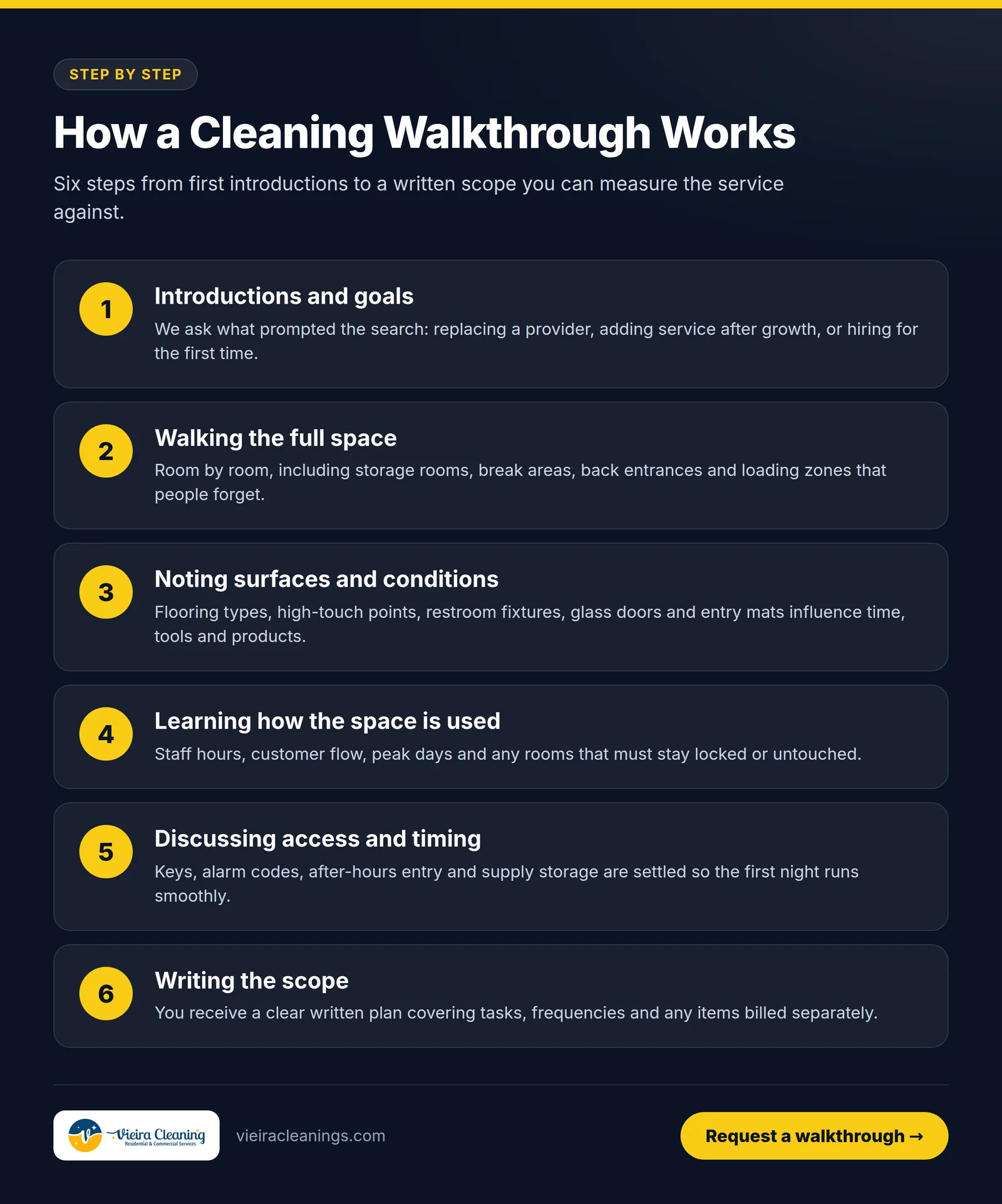
The order below is how we typically run a walkthrough, so you know what to expect and can prepare.
- Introductions and goals. We start by asking what prompted the search. Are you replacing a provider, adding service after growth, or hiring for the first time?
- Walking the full space. We go room by room, including areas people forget to mention, such as storage rooms, break areas, back entrances and loading zones.
- Noting surfaces and conditions. Flooring types, high-touch points, restroom fixtures, glass doors and entry mats all influence time, tools and products.
- Learning how the space is used. We ask about staff hours, customer flow, peak days and any rooms that must stay locked or untouched.
- Discussing access and timing. Keys, alarm codes, after-hours entry and supply storage are settled here so the first night runs smoothly.
- Writing the scope. You receive a clear written plan covering tasks, frequencies and any items billed separately.
Bring whoever will live with the result. An office manager notices different things than an owner, and a clinic lead sees details that a property manager may not.
Janitorial services Merced buyers should define area by area
The most useful thing you can do during the visit is attach a decision to every zone. The table below shows how that works in practice. The frequencies are examples of the kind of choice you will make, not a fixed menu.
| Area | What we look at | Decision to make |
|---|---|---|
| Entrance and lobby | Door glass, mats, hard flooring, reception counter | Daily wipe-down, or daily plus a weekly detail pass |
| Restrooms | Fixture count, partitions, floor drains, dispensers | Every visit, with restocking of paper and soap included |
| Open work areas | Desks, carpet or hard floor, trash and recycling points | Vacuuming and trash removal nightly or three times a week |
| Break room | Counters, sinks, microwaves, refrigerator exteriors, floors | Daily surfaces, with a scheduled day for appliance exteriors |
| Private offices and meeting rooms | Confidential papers, personal items, tables | Which rooms are cleaned, which are skipped, and who unlocks them |
| Storage, back-of-house and loading areas | Dust, debris, floor condition, safety paths | Weekly or monthly, and who clears items first |
Notice that most rows end in a choice, not a price. Once those choices are made, the cost follows from the scope instead of the other way around.
How janitorial, commercial and office cleaning differ
People often ask whether cleaning and janitorial service are the same thing. Not quite. A one-time clean addresses a space once. Janitorial service is the recurring routine that keeps a building at a steady standard, week after week. The U.S. Census Bureau profile for janitorial services describes the industry as establishments primarily engaged in cleaning building interiors.
So what is included? A typical janitorial scope covers trash removal, restroom sanitizing and restocking, floor care, dusting and high-touch surface cleaning. Anything beyond the routine, such as a deep reset before an inspection, is scoped separately.
The line between janitorial and commercial cleaning is mostly about breadth. Commercial cleaning is the wider category covering many business types and project types. Janitorial is the ongoing maintenance inside it. If your space is mainly desks and meeting rooms, our office cleaning services may be the closer fit, and the walkthrough helps us tell you honestly which one you need. For more on how local offices approach this, read our post on commercial cleaning for Merced offices.
Frequency decisions that shape the agreement
Frequency is where most agreements either work or quietly fail. Too little, and the building slips between visits. Too much, and you pay for work nobody can see. The walkthrough is the moment to match visit frequency to how the space is actually used.
Think in layers instead of one schedule for everything:
- Every visit: trash, restrooms, entrances, break room surfaces and floors in high-traffic paths.
- Weekly: dusting of lower surfaces, detailed floor edges, partition wiping and interior glass doors.
- Monthly or seasonal: baseboards, vents you can reach from the floor, storage areas and a deeper floor pass.
- As needed: a reset after a busy season, a move, a renovation or a long closure. Our deep cleaning services cover that kind of one-time reset.
Seasonal context matters in the Central Valley. Dry summer dust tracks in through every door, and winter rain brings mud into entryways. A business in Merced may want extra entry attention at different times of year than one in Hilmar or Turlock. Tell us about those patterns and we will build them into the plan.
Common mistakes to avoid before you sign
Mistake 1: Comparing quotes with different scopes
Two quotes can look similar and cover very different work. Ask each provider for a written task list by area and frequency, then compare lists before comparing totals. Our janitorial contract guide explains which clauses deserve a second read.
Mistake 2: Leaving out the places staff rarely see
Storage rooms, back hallways and loading zones are easy to forget on a tour. If they are not named in the scope, they are usually not cleaned. Mention them during the visit, even if the answer is that they stay off the list for now.
Mistake 3: Skipping the conversation about supplies and access
Who provides paper products, who holds keys and what happens if an alarm trips are small details with big consequences. Settle them in writing, along with a named contact on each side for questions.
Mistake 4: Having no way to measure the result
Agree on how you will judge the first month. A simple walkthrough of the finished space with your manager, plus a short check-in after the first few weeks, catches small gaps before they become habits.
What to prepare before the walkthrough
A little preparation shortens the visit and sharpens the scope. Gather the following before we arrive:
- Your staff schedule and the hours the building is empty
- A short list of past cleaning frustrations, so we know what to fix first
- Any areas with security, privacy or compliance needs
- Your must-have outcomes, such as a polished entrance for client meetings
- Questions about your current provider’s gaps, if you are switching
Frequently Asked Questions
What is the difference between cleaning and janitorial services?
Cleaning can be a single event, while janitorial service is a recurring routine that keeps a building at a steady standard. Janitorial work usually includes trash removal, restroom care, floor care and high-touch surfaces on a set schedule. One-time resets, such as a deep clean before an inspection, are typically scoped as separate projects.
What is included in janitorial services?
Most scopes cover trash and recycling removal, restroom sanitizing and restocking, vacuuming and mopping, dusting, and wiping of desks, counters and handles. The exact list depends on your building. That is why the walkthrough matters: it turns a general list into named tasks for each area and a frequency for each one.
What is the difference between janitorial and commercial cleaning?
Commercial cleaning is the broader category covering work in many business settings, including one-time projects. Janitorial service is the ongoing maintenance within it. A business with steady daily use usually wants janitorial scheduling, while a space needing a one-time reset may start with a project before moving to a recurring plan.
Should I attend the walkthrough myself?
Yes, or send the person who will oversee the service day to day. Owners, office managers and facility leads each notice different details. Having the decision-maker present means priorities, access rules and off-limits rooms are settled in one conversation instead of passed along secondhand.
Book your walkthrough this week
The best next step is a short visit while your questions are fresh. Pick a day when the space is in normal use, bring the person who will oversee the service, and plan to leave with a written scope covering areas, frequencies and expectations. If anything in the plan feels off, say so during the visit. Adjusting a document is easy, and changing a signed agreement is not.
Ready to see it in person? Request a walkthrough for our janitorial services and we will build a plan around your space, your schedule and your standards.