Book post construction cleaning after the last trade leaves and before furniture or staff move in. Join the contractor’s final walkthrough, agree on a written scope, and plan three stages: rough clean, final clean and a touch-up before opening day. Cost depends on square footage, debris, finishes and visits, so a walkthrough quote is the most reliable way to compare providers.
Key takeaways
Join the contractor’s final walkthrough and note delicate finishes before cleaning begins.
Put the scope, number of visits and finish date in writing.
Schedule a short touch-up visit after furniture delivery and before opening.
Compare quotes by what is included, not by the total alone.
Set up routine janitorial service so the opening standard lasts.
To open on time, you book the final clean after the contractor finishes punch-list work and before furniture, inventory or staff move in. That sequence is what keeps post construction cleaning Modesto projects on schedule. Construction dust, adhesive residue and leftover debris do not wait politely until opening day, and a space that looks finished can still fail a tenant’s first walk-through.
Bring your cleaning partner in before the contractor leaves
Your timeline from final walkthrough to opening day
The three cleaning stages and what each one covers
Is post construction cleaning worth it?
What shapes the cost of a construction cleanup
Common mistakes that delay openings
Next step: schedule a walkthrough
Bring your cleaning partner in before the contractor leaves
Most delays start with one assumption: that the contractor’s crew will hand over a clean building. In practice, builders typically remove large debris and materials, but detailed cleaning is a separate scope. Ask for it in writing before the final payment is released.
Who cleans up after construction? Either the general contractor subcontracts it, or you hire a cleaning company directly. Hiring directly gives you control over the schedule and the standard. It also means one team is accountable for the result, instead of a punch list that bounces between trades.
A tenant improvement in a Modesto office and a new retail buildout leave very different messes, so your cleaning plan should match the actual project, not a generic template.
Your post construction cleaning Modesto timeline, step by step
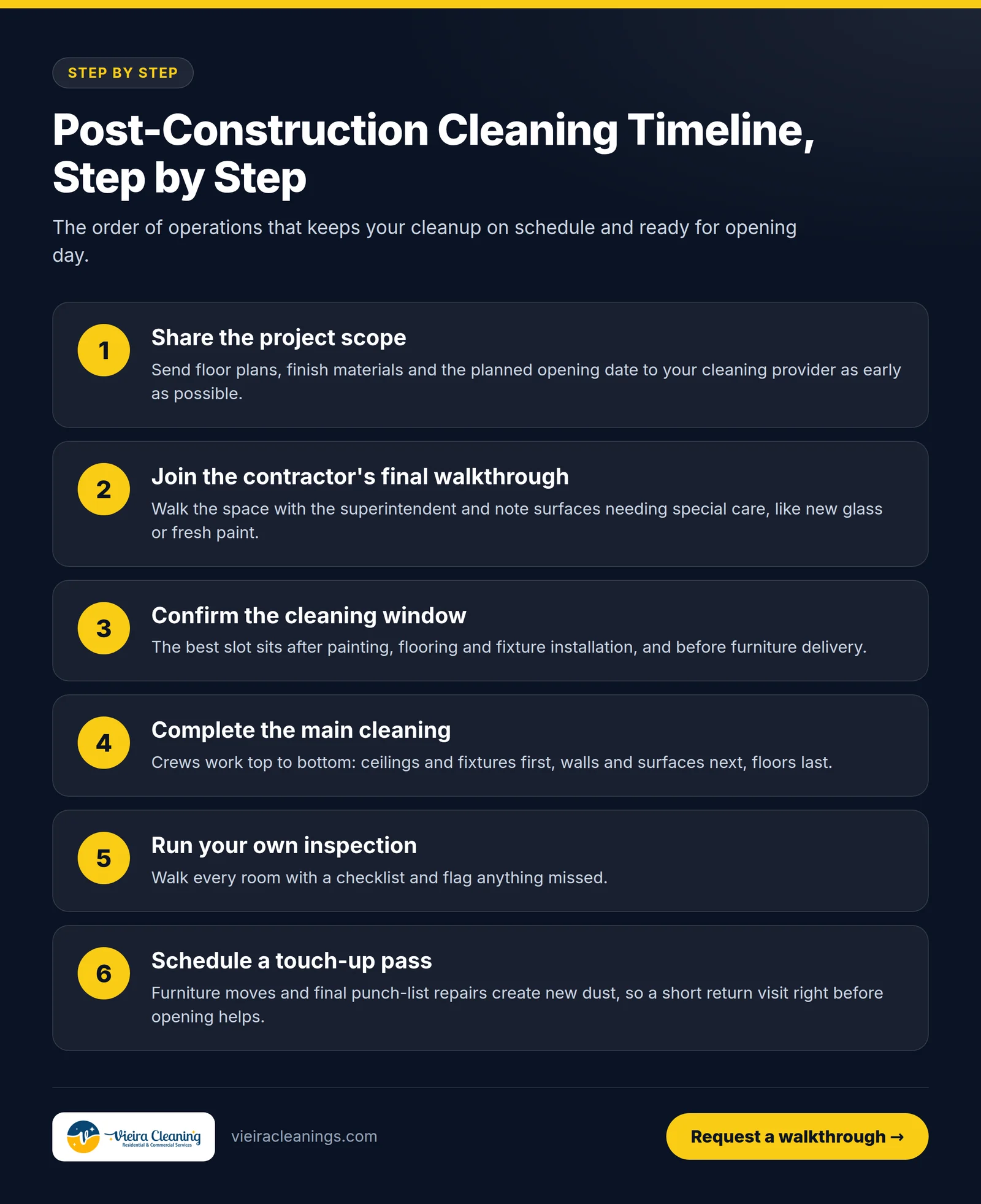
Use this order of operations. It works for tenant improvements, retail buildouts, clinic remodels and warehouse office additions across Modesto, Turlock and Merced.
Share the project scope. Send floor plans, finish materials and the planned opening date to your cleaning provider as early as possible.
Join the contractor’s final walkthrough. Walk the space with the superintendent and note surfaces that need special care, such as new glass, stainless steel, sealed concrete or fresh paint.
Confirm the cleaning window. The best slot sits after painting, flooring and fixture installation, and before furniture delivery.
Complete the main cleaning. Crews work top to bottom: ceilings and fixtures first, walls and surfaces next, floors last.
Run your own inspection. Walk every room with a checklist and flag anything missed.
Schedule a touch-up pass. Furniture moves and final punch-list repairs create new dust, so a short return visit right before opening protects your first impression.
Hand over to routine service. Set up ongoing janitorial or office cleaning so the standard holds after day one.
The three cleaning stages and what each one covers
Professional crews usually split the work into stages. The names vary between companies, but the logic is the same: remove the heavy mess first, then detail, then polish.
Stage
When it happens
Typical tasks
What you confirm
Rough clean
While trades are still finishing
Debris removal, sweeping, dust removal from open areas
Trash hauling is handled and access is clear
Final clean
After the last trade leaves
Surface wiping, cabinets and fixtures, restrooms, floors, interior glass, stickers and labels removed
Every room matches your checklist
Touch-up clean
Just before opening day
Dust from furniture setup, fingerprints, floor spots, restroom restock check
Space is move-in or customer ready
Skipping the first stage forces the final crew to spend its time on bulk removal. Skipping the last one means your staff or first customers meet the dust that settled after delivery day.
Is post construction cleaning worth it?
Yes, when you weigh it against the alternatives. Fine construction dust travels into vents, shelving, electronics and every horizontal surface, and general-purpose janitorial routines are not built to remove it. Your own staff would lose days of productivity, and finished surfaces can be scratched by the wrong tools.
There is also the professional image to consider. A medical clinic, retail store or office that opens with visible residue tells tenants and customers that details were missed. Our guide to the benefits of post construction cleaning for your facility goes deeper on the health and productivity side.
What shapes the cost of a construction cleanup
People often ask what the prices are for this work and how cleaners charge. The honest answer is that a reliable quote comes from a walkthrough, not a phone guess. Most providers price by square footage, scope, or a combination of both, so ask which method is used.
These factors move the quote:
Total square footage and number of rooms or floors
Amount of debris and residue left after trades finish
Finish types, such as polished concrete, tile, glass walls or stainless steel
Number of visits needed (rough, final, touch-up)
Access, such as elevators, stairs or tight loading windows
Your deadline and whether work must happen after hours
Ask every provider to list exactly what is included, so you can compare scopes rather than totals. A lower number that leaves out restrooms or interior glass often costs more once you add the missing work back in.
Common mistakes that delay openings
Mistake 1: Scheduling cleaning too early
If painters or flooring crews are still on site, the cleaning gets undone within days. Confirm the last trade’s departure date and book the final clean directly after it.
Mistake 2: No written scope
Verbal agreements lead to arguments about restrooms, cabinets or glass. Put the scope, the number of visits and the finish date in a short written document.
Mistake 3: Forgetting the touch-up visit
Furniture delivery, shelving installs and inventory stocking all create dust. Budget a short return pass so the space is photo-ready on the day you open.
Walk every room with the contractor’s punch list and your cleaning scope side by side
Check corners, baseboards, door tops, vents covers and light fixtures for dust
Inspect restrooms, break rooms and kitchenettes for residue and stickers
Look at floors under bright light, since streaks and film show up at an angle
Confirm trash and recycling bins are placed and stocked
Test that exits, hallways and entries are clear and safe to walk
Our team handles every stage of this process through our post construction cleaning services, coordinated around your contractor’s schedule here in the Central Valley.
Frequently Asked Questions
What are the prices for post construction cleaning?
Prices vary by project, so a walkthrough is the only reliable way to get one. Providers usually weigh square footage, debris level, finish types and number of visits. Ask each company to itemize inclusions such as restrooms, interior glass and the touch-up pass, so you compare equal scopes.
Who cleans up after construction?
The contractor removes large debris and materials, but detailed cleaning is usually separate. Either the contractor subcontracts it or you hire a cleaning company directly. Hiring directly gives you control over timing and quality, and you can add it to the contract before final payment.
How do cleaners charge for post construction cleanup?
Most charge by square foot, by a flat project rate, or by hourly crew time. Flat rates work best when the scope is clear. Hourly pricing suits unpredictable projects. Ask what happens if the site is dirtier than expected, so there are no surprise add-ons.
Can cleaning start before the final inspection?
A rough clean can start earlier, but the final clean should wait until inspections and punch-list repairs are done. Repairs and re-inspections create new dust and marks. Scheduling the detailed clean afterward avoids paying twice for the same surfaces.
Next step: schedule a walkthrough before the punch list closes
The best time to talk to a cleaning partner is while the contractor is still on site, because that is when dates can still be aligned. Bring your floor plan, finish list and target opening date, and you will leave with a clear scope and timeline. Request a walkthrough with Vieira Cleaning and get your space ready for opening day.
Schedule a commercial deep clean when routine janitorial work stops reaching buildup, typically at seasonal changes (late spring and early fall), before a lease ends, and before a new tenant or reopening. Book off-hours, define the scope in writing after a walkthrough, and follow with a regular cleaning program so the baseline lasts.
Key takeaways
Plan deep cleans around late spring and early fall in the Central Valley.
Book the lease turnover clean after move-out and before the final inspection.
Choose weekends or evenings and work in zones to protect operations.
Focus detail work on restrooms, break rooms, and entry areas first.
Update your routine cleaning scope after each deep clean.
A Modesto facility needs a scheduled deep clean when routine janitorial work no longer reaches the buildup that forms in corners, on high surfaces, and under equipment, and the best timing is usually tied to a seasonal change, a lease turnover, or a reopening. Planning deep cleaning services Modesto owners can rely on means choosing the date before the problem shows up in front of customers or staff.
Why routine cleaning and deep cleaning are different jobs
Timing trigger 1: seasonal changes in the Central Valley
Timing trigger 2: lease turnover and move-out
Timing trigger 3: new tenants and reopenings
What a commercial deep clean covers
A step-by-step plan with minimal disruption
Common scheduling mistakes
Your next step
Routine janitorial work and deep cleaning solve different problems
Nightly or weekly janitorial service keeps a space presentable. It empties trash, restrooms get restocked and sanitized, floors are vacuumed or mopped, and visible surfaces are wiped. That rhythm protects your professional image day to day.
A deep clean goes where the routine does not. Think baseboards, vent covers, door frames, light fixtures, the backs of reception counters, break room appliances, and the grout lines in restrooms. These areas collect residue slowly, so nobody notices until a client points it out.
The two services work best together. Our janitorial services handle the consistent upkeep, while a scheduled reset brings the whole building back to a clean baseline that the routine can then maintain.
Timing trigger 1: seasonal changes in the Central Valley
Modesto has dry, dusty summers and a wetter stretch in winter, and both leave a mark indoors. Dust and fine grit travel in on shoes and through open doors, while rainy weeks bring mud and moisture onto entry floors and mats.
Two natural windows tend to work well for most offices, clinics, and retail stores:
Late spring: clear out winter buildup before the heavy summer foot traffic and heat.
Early fall: reset after dusty summer months and before the holiday rush, year-end client visits, and open enrollment season.
Agricultural activity around Modesto, Turlock, and Merced also puts extra dust into the air during harvest periods. Warehouses and shop-front businesses near open fields often notice it on windowsills, shelving, and entry floors first.
Timing trigger 2: lease turnover and move-out
When a lease ends, the condition of the space affects your security deposit conversation and how fast the unit can be shown or re-let. A deep clean before the final walkthrough removes the buildup that normal cleaning leaves behind, so the landlord inspects a space that looks cared for.
For property managers, the same logic applies between tenants. A clean, neutral unit photographs better, shows better, and avoids disputes about what was or was not left behind.
Book the clean after the last furniture and equipment are out, but before the final inspection. Leave at least a day of buffer in case a second visit is needed for touch-ups.
Timing trigger 3: new tenants and reopenings
A new tenant moving into a vacant suite inherits whatever the previous occupant left, plus dust that settled while the space sat empty. Starting with a deep clean means staff begin work in a space that feels ready, and your routine cleaning program starts from a fair baseline.
Reopenings follow the same pattern. After a remodel, a long closure, or a seasonal shutdown, a reset helps the doors open on a clean space. If the reopening follows construction work, a dedicated post-construction cleaning comes first, and the deep clean finishes the details.
What a commercial deep clean typically covers
Scope varies by building, which is why a walkthrough matters. The table below shows how routine work and a scheduled deep clean usually divide the tasks.
Area
Routine janitorial
Scheduled deep clean
Restrooms
Sanitize fixtures, restock, mop
Scrub grout, descale fixtures, wipe partitions and vent covers
Break room
Wipe counters, empty trash
Clean inside and behind appliances, cabinet fronts, sink fixtures
Floors
Vacuum and mop open areas
Edges, corners, under movable furniture, detailed hard-floor cleaning
Work areas
Dust visible surfaces, empty bins
Baseboards, door frames, high ledges, light fixture exteriors
Entry and reception
Wipe glass doors and counters
Detail work on handles, thresholds, seating, and walls
Pricing depends on square footage, layout, and condition, so we quote after seeing the space rather than guessing from a number. You can read more about our approach on the deep cleaning services page.
A step-by-step plan with minimal disruption
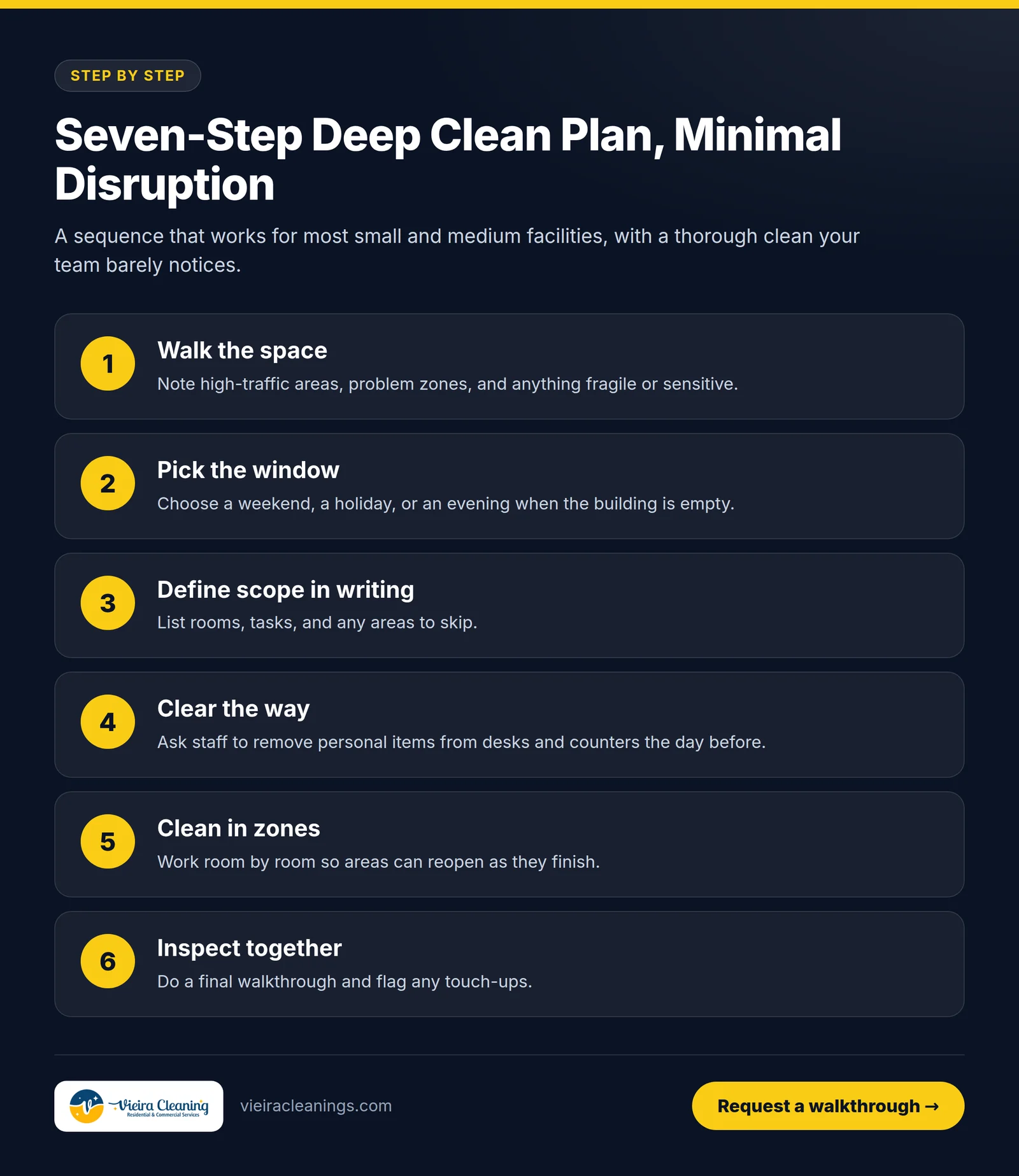
The goal is a thorough clean that your team barely notices. This sequence works for most small and medium facilities.
Walk the space. Note high-traffic areas, problem zones, and anything fragile or sensitive.
Pick the window. Choose a weekend, a holiday, or an evening when the building is empty.
Define scope in writing. List rooms, tasks, and any areas to skip.
Clear the way. Ask staff to remove personal items from desks and counters the day before.
Clean in zones. Work room by room so areas can reopen as they finish.
Inspect together. Do a final walkthrough and flag any touch-ups.
Hand off to routine service. Update the regular cleaning scope based on what the deep clean revealed.
Medical and retail spaces benefit from extra care with scheduling, since patient hours and store hours limit the open windows. For a primer on building a plan around your hours, see our guide to what a janitorial contract in Modesto should cover.
Common scheduling mistakes
Mistake 1: Waiting for a visible problem
By the time a client comments on dusty vents or a stained break room, trust has already taken a small hit. Schedule on a calendar, twice a year for many offices, instead of reacting.
Mistake 2: Booking during peak hours
Cleaning around active staff slows the job and frustrates everyone. Off-hours service protects both quality and productivity.
Mistake 3: Skipping the follow-up routine
A deep clean without a good regular program fades fast. Pair it with consistent service, such as the options covered in our office cleaning services in Modesto post.
Mistake 4: Assuming every room needs the same attention
Restrooms, break rooms, and entries usually need the most detail. A targeted scope saves time and keeps the focus where visitors notice.
Frequently Asked Questions
How much should I expect to pay for a deep clean?
Cost depends on square footage, layout, and how much buildup has accumulated, so reliable pricing comes from a walkthrough rather than a flat number. A small office and a multi-room clinic need very different time and labor. Ask for a written scope so you can compare quotes on the same tasks.
What is typically included in a commercial deep clean?
A deep clean usually covers detail work that routine service skips, such as baseboards, door frames, high ledges, restroom grout, break room appliances, and floor edges. Exact tasks vary by building. Confirm the list in writing before the visit, and note any areas that should be excluded.
How often should an office schedule a deep clean?
Many offices schedule one twice a year, often in late spring and early fall. Higher-traffic spaces such as clinics or retail stores may need it more often. Your walkthrough findings and visitor volume are better guides than a fixed rule.
Can a deep clean happen without closing my business?
Usually yes, if the work is done off-hours or in zones. Evenings, weekends, and holidays work best, and cleaning room by room lets areas reopen as they finish. Some tasks, like detailed floor work, need a space to be empty for a few hours.
Request a walkthrough for your Modesto facility
If your building is approaching a seasonal change, a lease end, or a new opening, the best time to plan is a few weeks ahead. Our team will review the space, agree on scope, and schedule the work around your hours. Request a walkthrough and quote from Vieira Cleaning to get a date on the calendar.
A practical tip: put your deep clean dates on the same shared calendar you use for inspections, renewals, and staff events. When the date is visible months ahead, it is far easier to protect the evening or weekend slot, and your team can plan around it without last-minute surprises.