TL;DR
An effective office cleaning checklist sorts tasks by frequency: daily for trash, restrooms, high-touch surfaces and floors; weekly for dusting, full vacuuming and mopping; monthly for vents, baseboards and deep floor work. Assign repetitive, equipment-based tasks to a janitorial team and personal desk habits to staff, then use the list as the basis for a walkthrough request.
Key takeaways
- Sort every task into daily, weekly or monthly so no area depends on someone remembering it.
- Name actions such as wipe counters and mop floors instead of listing rooms.
- Give high-touch surfaces like handles, switches and reception counters their own daily line item.
- Hand restrooms, floors and trash to a janitorial team and keep personal desk items with staff.
- Bring square footage, restroom count, surface types and access hours to the walkthrough.
A good cleaning scope splits every task into daily, weekly and monthly work, then assigns each one to either your staff or a professional janitorial team. Writing it down once removes most of the guesswork and the missed spots. This office cleaning checklist gives you a starting point you can adjust for your own floor plan and foot traffic.
Most cleaning complaints in small and mid-sized offices come from unclear scope, not from bad effort. Nobody agreed on who empties the break room fridge or who wipes the glass doors. A written list fixes that.
- How to build an office cleaning checklist that fits your space
- Daily tasks that keep the office presentable
- Weekly tasks that stop buildup
- Monthly tasks that protect surfaces and floors
- Which tasks belong to a professional team
- Common mistakes when writing a cleaning scope
- Turning the checklist into a walkthrough request
- Request a walkthrough for your office
How to build an office cleaning checklist that fits your space
Start with how people actually use the building. A front desk that greets walk-in clients needs more attention than a back office with four desks. A shared kitchen needs more than a storage room.
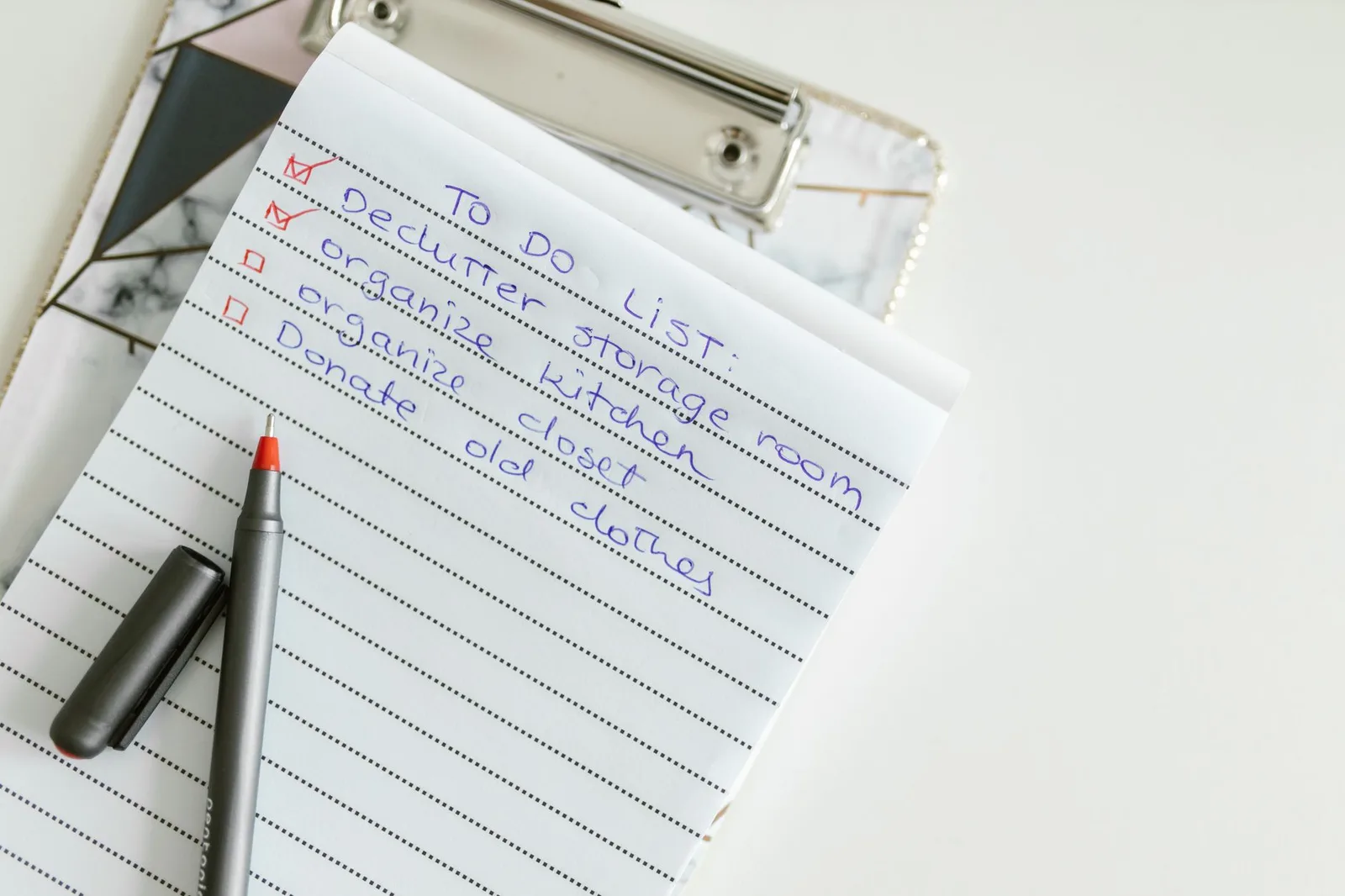
Walk the space once with a notepad and divide it into zones: entrance and lobby, workstations, restrooms, break room, conference rooms, hallways and storage. Then note the surfaces in each zone, such as glass, laminate, carpet, tile and upholstery. Surface type decides which method and product the crew should use.
Public health groups publish simple routine cleaning checklists for office space, and the routine cleaning checklist from the University of South Carolina environmental health and safety office is one example of how a task list can be organized for an office. Use a document like that as a model, then adapt it to your own rooms and schedule.
Daily tasks that keep the office presentable
Daily work is what clients and employees notice first. It covers trash, touch points, restrooms and floors. If your crew visits after hours, this is the core of every visit.
- Empty all trash and recycling bins and replace liners
- Wipe and disinfect high-touch points: door handles, light switches, elevator buttons, shared appliance handles and reception counters
- Clean and restock restrooms: toilets, sinks, mirrors, soap, paper towels and tissue
- Wipe break room counters, tables and the sink; clean the microwave exterior
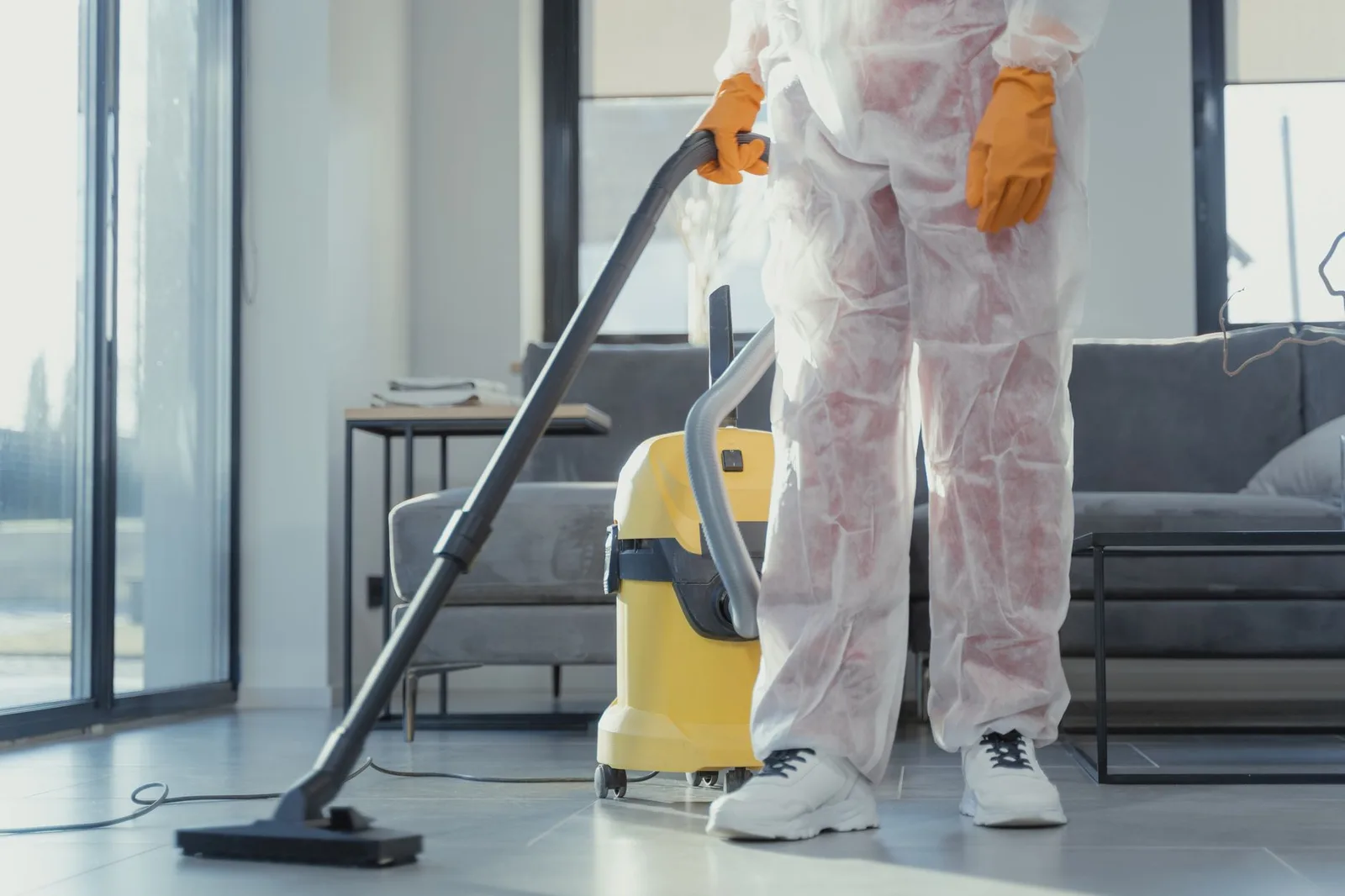
- Vacuum high-traffic carpet and dust-mop or damp-mop hard floors
- Spot clean glass at the entrance and on reception doors
- Straighten common areas such as the waiting room and conference tables
Desks are a special case. Crews generally clear and wipe desks only when they are tidy, so ask employees to put loose papers away at the end of the day. That one habit helps the crew do a better job in less time.
Weekly tasks that stop buildup
Weekly tasks target the dust and grime that daily visits skip. Left alone, these areas look fine for a few days and then suddenly look neglected. Many public agencies publish a weekly cleaning checklist for exactly this reason: recurring work is easier to keep up when it has its own list.
- Dust desks, shelves, window sills, blinds and computer monitor frames
- Vacuum the full carpet, including edges and under desks that are reachable
- Mop all hard floors, including corners and doorways
- Wipe down chairs, phone handsets and shared keyboards or copier panels
- Clean the inside of the microwave and wipe the refrigerator handle and shelves in the break room
- Disinfect restroom walls and partitions, and clean floor drains and baseboards
- Remove fingerprints from interior glass and glass partitions
For a deeper look at building a weekly rhythm, see our weekly cleaning guide for professionals.
Adjust the list to your entrance traffic
Entrance mats, door tracks and vent covers often collect more dirt than the rest of the office. If your entrance sees heavy foot traffic, move entrance floors and window sills to a more frequent schedule.
Monthly tasks that protect surfaces and floors
Monthly work is where an office goes from clean to well maintained. These tasks take more time and often need equipment, so they are usually scheduled as a separate block rather than squeezed into a nightly visit.
- Dust vents, ceiling corners, light fixtures and the tops of cabinets and door frames
- Wash baseboards and wipe down walls where hands and chairs leave marks
- Clean interior windows and glass in conference rooms
- Move light furniture and clean beneath it
- Scrub restroom grout and deep clean tile floors
- Wash trash cans and recycling bins inside and out
- Clean the break room refrigerator thoroughly and descale the coffee area
If you have never done a full reset, a one-time deep clean can bring the office up to a standard that a regular schedule can then maintain. Our guide to upgrading your office cleaning routine explains how to make that shift.
Which tasks belong to a professional team
Not every item needs a vendor. Staff can handle small personal habits, while a janitorial team should own anything that is repetitive, equipment-based or hygiene-sensitive. Splitting duties this way keeps costs predictable and avoids arguments about whose job it is.
| Task | Frequency | Best owner | Reason |
|---|---|---|---|
| Clearing personal desk items and dishes | Daily | Employees | Only the owner knows what to keep |
| Restroom cleaning and restocking | Daily | Janitorial team | Needs disinfectant, method and consistency |
| Trash and recycling removal | Daily | Janitorial team | Predictable, time-consuming |
| Vacuuming and mopping | Daily or weekly | Janitorial team | Requires commercial equipment |
| Wiping the fridge of expired food | Weekly | Employees, with reminders | Staff know what belongs to them |
| Dusting vents, fixtures and baseboards | Monthly | Janitorial team | Needs reach tools and a methodical process |
| Deep floor and grout cleaning | Monthly or quarterly | Janitorial team | Calls for trained crews and the right products |
Our office cleaning services cover the janitorial column above, and we tailor the frequency to the size and traffic of each space.
Common mistakes when writing a cleaning scope
Mistake 1: Listing rooms instead of tasks
A line that says “clean the break room” can mean anything. Name the actions instead: wipe counters, clean the sink, empty trash, mop the floor. Specific tasks make results easy to check.
Mistake 2: Putting everything on the daily list
Dusting vents every night wastes time and raises the cost of the service without improving the result. Match each task to a realistic frequency so the crew can focus on what matters most each visit.
Mistake 3: Ignoring high-touch surfaces
Door handles, shared appliances and reception counters get touched all day. They deserve their own line item, not a vague mention under general wiping.
Mistake 4: Forgetting to define what is excluded
Say plainly what staff will handle, such as personal desk items, and what falls outside the scope. Clear boundaries prevent surprises for both sides.
Turning the checklist into a walkthrough request
A checklist is most useful when it becomes the basis for an on-site walkthrough. Here is how to prepare.
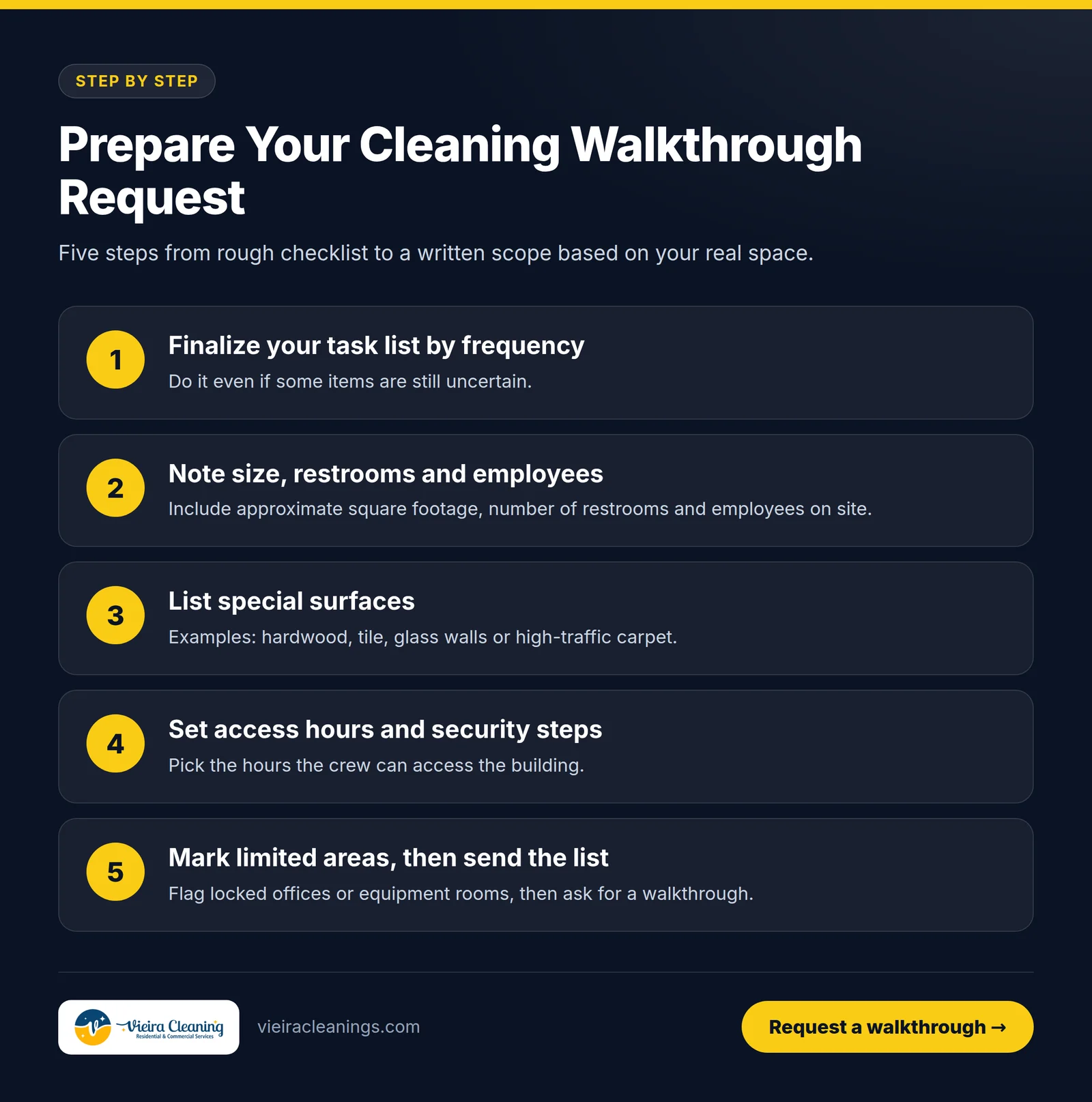
- Finalize your task list by frequency, even if some items are still uncertain.
- Note the approximate square footage, number of restrooms and number of employees on site.
- List special surfaces, such as hardwood, tile, glass walls or high-traffic carpet.
- Pick the hours the crew can access the building and any security steps they need to follow.
- Mark any areas with limits, such as locked offices or equipment rooms.
- Send the list and ask for a walkthrough so the scope is based on the real space.
During the walkthrough, expect questions about foot traffic, supplies and any tasks that fall outside routine visits. If your needs go beyond cleaning, such as training your team on a consistent system, ask about it at the same time. A janitorial service plan can also be built around your hours, so the work happens when your team is not in the way.
Frequently Asked Questions
What should I include on my office cleaning list?
Include trash removal, restroom cleaning, high-touch surface disinfection, floor care, break room wiping and dusting. Group them by daily, weekly and monthly frequency. Add special tasks for your space, such as glass partitions or entrance mats, and note who owns each task so nothing falls between staff and the cleaning crew.
What does office cleaning typically include?
Routine office cleaning typically covers emptying trash, cleaning restrooms, wiping surfaces, vacuuming and mopping. Many plans also include break room cleaning and dusting. Scope varies by provider and contract, so ask for a written task list. Deep cleaning of items like vents or grout is often scheduled separately.
What affects the quote for cleaning a 2,000 sq ft office?
Square footage alone does not set the scope. Visit frequency, restroom count, floor types and after-hours access all change the work involved. A walkthrough is the reliable way to get an accurate quote, because two offices of the same size can need very different work.
How often should an office be professionally cleaned?
Most offices with regular foot traffic do well with professional visits several times a week, while smaller low-traffic offices may need less. Restrooms and trash need the most frequent attention. Base the schedule on your employee count, client visits and how quickly spaces get dirty rather than on a fixed rule.
Should employees clean their own desks?
Employees should clear personal items and papers, and the cleaning crew can then wipe the surface. Crews generally avoid moving documents or electronics on cluttered desks. A simple end-of-day rule to tidy desks helps the team clean thoroughly. Staff can also handle their own dishes and food in shared areas.
Request a walkthrough for your office
Bring your checklist, even if it is rough, and we will adjust it room by room for your office in Hilmar, Turlock, Modesto, Merced or the surrounding Central Valley. Contact Vieira Cleaning to schedule your walkthrough and get a clear, written scope.